
· by Michael Blair, Nashville's Drainage and Excavation
Piping downspouts underground and out to the yard is one of the best things a Nashville lot can have, because roof water is the largest single volume of water around most foundations. But a buried line is out of sight, and it fails quietly. Leaves wash down from the gutters every October and November, roots find the joints, and a section under the lawn gets crushed by a mower or a truck. When the line stops, the water backs up at the downspout and pours out right where it was meant to be kept away from.
Signs the line is blocked
Water spilling out of the gutter at the corner where the downspout drops, even though the gutter itself is clean, is the classic sign. The downspout is full to the top because the pipe below cannot take it. Water bubbling up around the joint where the downspout enters the ground, a pop-up emitter that stays closed in heavy rain, and a wet patch near the foundation that was dry in past years all point the same way.
A soggy strip across the lawn along the route of the pipe means something different: the line is broken or disconnected, and the water is leaving it partway along.
Testing the line with a hose
Disconnect the downspout at the ground, or cut into the adapter if there is no clean way in, and run a garden hose into the pipe at full flow. Give it a few minutes and watch the outlet. If water arrives there steadily, the line is open and the problem is higher up, in the gutter or downspout. If nothing arrives, or water backs up at the top, the line is blocked or broken.
Time how long water takes to appear and walk the route while it runs. A spot where the ground softens or water rises to the surface marks the break. On a longer run, a drain camera pushed from the top end shows exactly where the blockage is and what it is, which saves digging up the whole line to find out.
The usual causes
Leaves and gutter grit are the most common, especially where there is no screen or leaf filter at the top of the downspout. Black corrugated pipe, which is what many of these lines were laid with, catches debris in every ridge and is easy to crush. Roots get in at joints that were never glued. And a line laid without steady fall, or one that has sagged as the clay under it settled, holds water in the low spot, where sediment collects until it fills.
At the far end, pop-up emitters get jammed by grass growing over them, sediment in the lid, or a mower. In a cold snap, water sitting in a line that does not drain completely can freeze at the emitter and block it until it thaws.
- Leaves and roof grit with no filter at the top
- Crushed corrugated pipe under a driveway or path
- Roots at unglued joints
- A sag in the line that holds silt
- An emitter grown over or jammed shut
Fixing it and keeping it clear
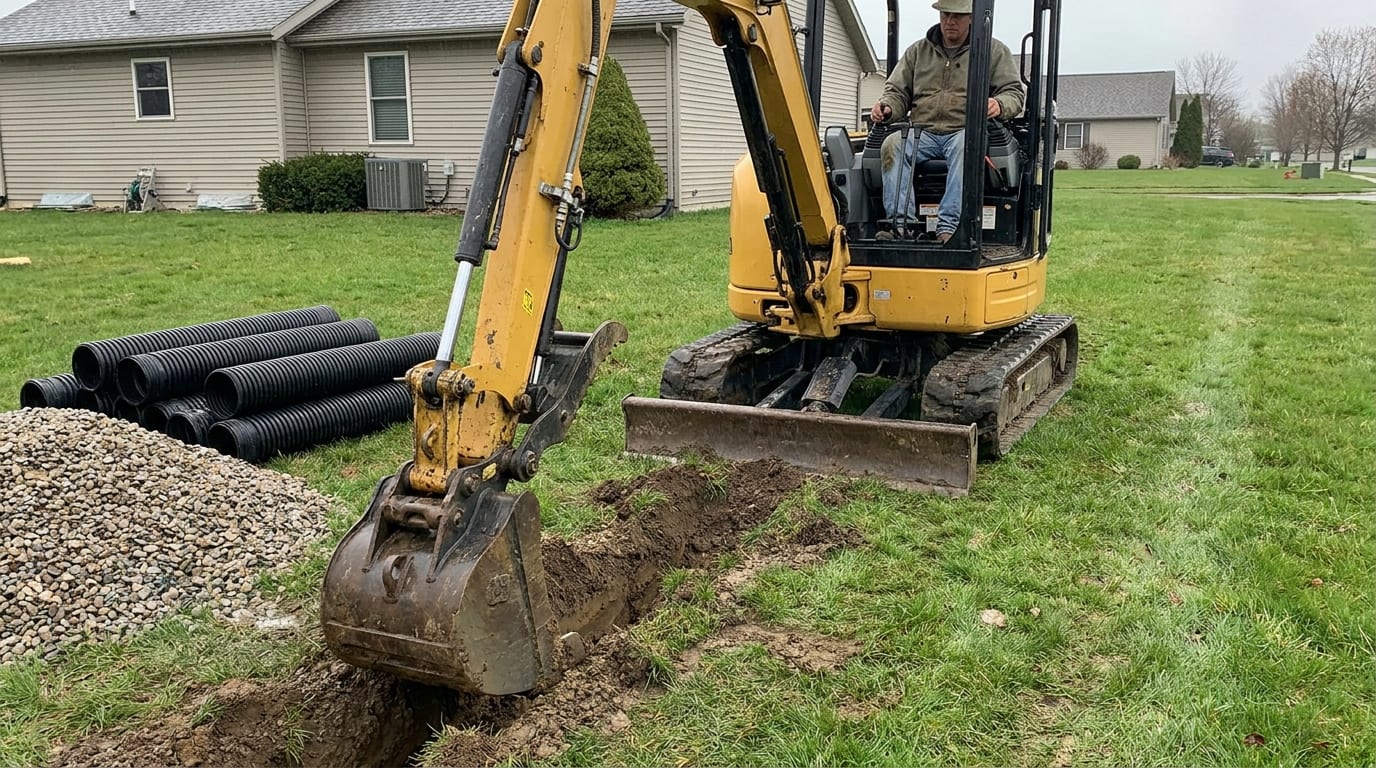
A blockage near the top can often be flushed out with a hose or cleared with a drain snake. A crushed or badly sagged section has to be dug up and replaced, and where the whole line is corrugated pipe, replacing it with smooth-wall pipe at a steady fall and glued joints is usually the lasting fix. A cleanout fitting at the top, where the downspout connects, makes the next flush a two-minute job.
For upkeep, put a debris filter or a screened adapter at the top of each downspout that feeds a buried line, and check it after the leaves are down in November. Clear the grass from around each emitter in the fall so it can open. Always have utilities marked through Tennessee 811 before digging to repair or replace a line, even a shallow one.