
· by Michael Blair, Nashville's Drainage and Excavation
Most people learn they have a drainage easement when they plan a fence, a shed or a pool, or when the low strip behind the house starts holding water. It is a line on the subdivision plat, often labeled public utility and drainage easement, that lets water from other lots cross yours. This is how drainage easements work in Davidson County: what the strip is for, what Metro maintains and what stays with the owner, what can go inside it, and how to find where yours runs.
What is a drainage easement on my property?
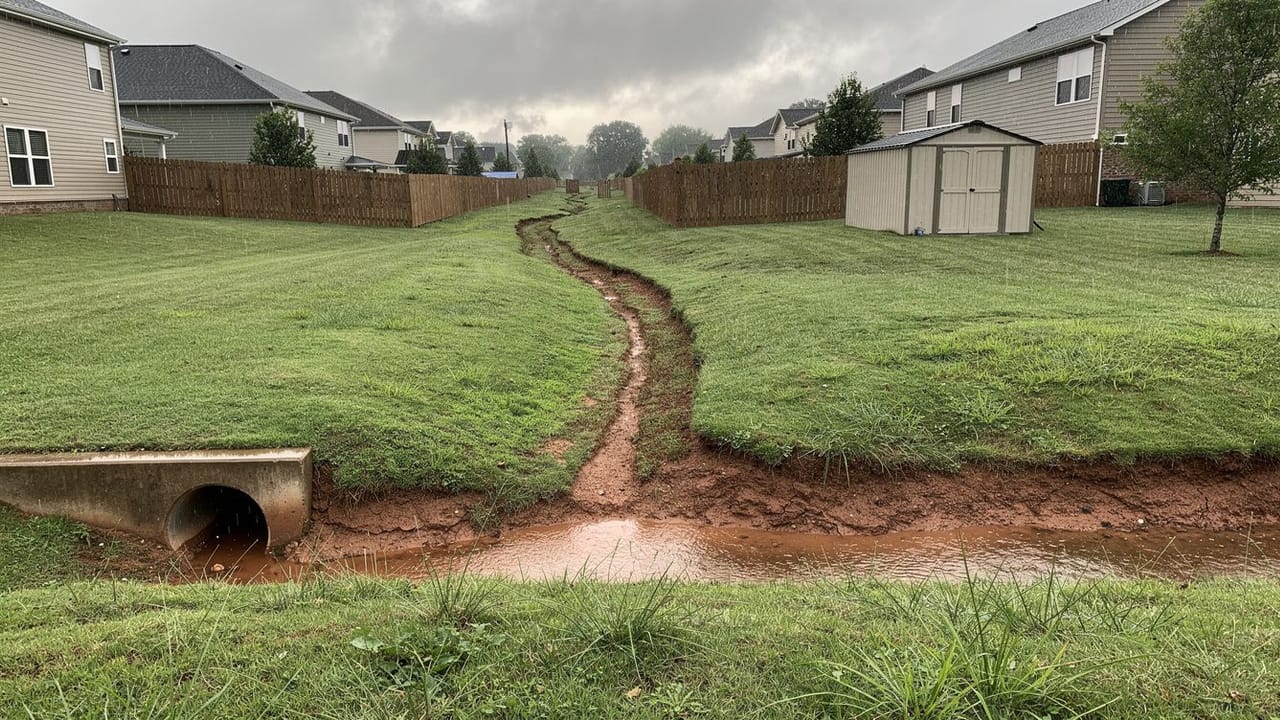
A drainage easement is a strip of your lot set aside to carry stormwater, usually from the lots and streets above you to an outlet below, and recorded on the plat when the subdivision was approved. You still own the ground and pay taxes on it. What you give up is the right to block the water or change its path through that strip.
Metro’s rules explain why the strips exist. The Metro Stormwater Management Manual, Volume 1, Chapter 6 (February 2016) makes the developer or owner responsible for taking the runoff that arrives from the watershed above and carrying it across the property to an adequate outlet, and it places that conveyance in a public utility and drainage easement. Every open channel has to sit inside one, sized and labeled on the plat.
The same chapter sets the widths. For a channel less than 5 feet across at the top, Table 6-1 calls for a 10-foot easement centered on it, and for a channel 5 to 20 feet wide, 5 feet on both sides. Storm pipes and culverts get widths from a second table based on the pipe and how deep it is buried.
Who maintains a drainage easement in Nashville?
In most cases the owner maintains the ground inside a drainage easement, and Metro Water Services steps in only where the public system or public safety is involved. Metro’s stormwater maintenance page lists what it handles, among them flooding of public roads, roadside ditches and driveway pipes, drains under the road, clogged storm drains, and trees that block drainage. It leaves to owners the removal of weeds and vegetation, mowing ditches, runoff from one private lot to another, and fallen trees that do not block the flow.
Subdivision ponds and other stormwater control measures are a separate case. Chapter 6 requires them to sit in public utility and drainage easements and to be maintained by the landowner or the homeowners association, under a recorded maintenance document with scheduled inspections reported to Metro.
When something inside an easement fails, the question of who pays is narrow. A 2022 memo from the University of Tennessee’s Municipal Technical Advisory Service on liability for failing drainage systems tells cities the answer turns on whether the failure is on public property, or in a drainage easement the city holds where the city installed what failed. Where neither is true, the city generally has no duty to maintain the drain. Our post on a neighbor’s runoff onto your yard covers the private side.
Can you build or fence inside a drainage easement?
You can sometimes fence across a drainage easement with approval, but anything that blocks or reroutes the water inside it needs Metro’s sign-off first. Chapter 6 states that any alteration or addition to Metro’s stormwater management system requires the approval of Metro Water Services, and a shed, slab or wall set in the flow path is exactly what an easement exists to prevent.
For fences, Metro Codes’ fence guidance says a fence should not go in a drainage ditch, a flood overlay or a stream buffer without Metro Stormwater approval, and that building within a utility easement takes the utility’s permission. A fence across a swale also catches leaves and limbs, which is how a backyard ditch turns into a pond.
Filling, regrading or piping a swale changes the flow path too, and grading can need a permit of its own, as our post on grading permits in Davidson County explains. When an easement swale holds water or erodes, the repair is usually to restore the grade it was built with, the yard grading work we do, with Metro’s approval where the system is public.
Finding the easements on your lot
The recorded subdivision plat is the first place to look, because drainage easements are drawn and labeled on it, but it is not the last. Metro Codes notes that it keeps no easement records, that a plat may not show every easement affecting a lot, and that title work, a land survey or the utility can fill the gaps.
On the ground, the clues are a shallow swale along a rear or side line, a storm inlet or pipe outlet in a back yard, or a grassy channel between houses that only runs in storms. If you are planning a fence, a shed or drainage work near one, or the swale behind your house in Bellevue or anywhere else in Davidson County has stopped draining, ask us to look at it before anything is built in its path.
Sources
- Metro Nashville–Davidson County Stormwater Management Manual, Volume 1, Chapter 6: Technical Guidelines and Criteria (February 2016) — Owner carries runoff from above to an adequate outfall inside a public utility and drainage easement; alterations to the Metro system need MWS approval; Table 6-1 easement widths; stormwater control measures in easements maintained by the landowner or HOA.
- Metro Water Services, Stormwater Maintenance — What Metro maintains (roadside ditches, driveway pipes, drains under the roadway, clogged storm drains) and what stays with the property owner (vegetation, mowing ditches, private-to-private runoff).
- Metro Codes, Fence (Building Permits Central) — No fence in a drainage ditch, flood overlay or stream buffer without Metro Stormwater approval; utility permission for utility easements; Codes keeps no easement records; plats may not show every easement.
- University of Tennessee Municipal Technical Advisory Service, Municipal Liability for Damages Caused by Failing Drainage Systems (May 2022) — City liability turns on public property or a city-held drainage easement with city-installed infrastructure; otherwise no general duty to maintain private drains.
FAQ
Drainage Easement on Your Property in Nashville — questions
Can I put a shed in a drainage easement?
Generally not without approval, and often not at all. Metro’s stormwater manual says any alteration or addition to the stormwater system needs Metro Water Services approval, and a shed on a slab or blocks in a swale changes where the water runs. The simpler answer is to set the shed on high ground outside the easement.
Can I fill in the ditch in my drainage easement?
Not on your own. The ditch is the conveyance the easement protects, and Metro’s manual requires Metro Water Services approval for any change to the stormwater system. Filling or piping it pushes water onto someone else, and the grading itself can need a permit. Restoring the swale’s grade is usually the better repair.
How wide is a drainage easement in Davidson County?
It depends on what it carries. Metro’s stormwater manual sets a 10-foot easement centered on an open channel less than 5 feet wide at the top, and 5 feet on both sides of a channel 5 to 20 feet wide. Wider channels and storm pipes get wider strips. Your plat shows the actual width.
Who pays to fix a failing pipe in a drainage easement?
It turns on who holds the easement and who built the pipe. MTAS advises Tennessee cities that they answer for drainage failures on public property, or in a city-held easement where the city installed what failed. Otherwise a private pipe across private lots usually stays with the owners or the homeowners association.
Does Metro mow the drainage ditch behind my house?
No. Metro Water Services lists mowing ditches and removing weeds and vegetation as the property owner’s job. It does handle roadside ditches, driveway pipes, drains under the road, clogged storm drains and trees that block drainage. A backyard swale is the owner’s to keep mowed and clear so the water keeps moving.