
· by Michael Blair, Nashville's Drainage and Excavation
Before a crew digs a drain trench or reshapes a yard, someone should ask whether the job needs a permit. In Davidson County, the permit in question is a grading permit from Metro Water Services, and for most residential drainage work the answer is no. It is not always no, though, and the cases where it changes, a lot near a creek or in a watershed that drains to a sinkhole, are ones we check every time. Here is how Metro draws the line, as it applies to excavation and yard grading on a Nashville lot.
What counts as grading in Davidson County
More than people expect. Metro Water Services’ page Who Needs A Grading Permit says the permit is issued by its Stormwater Division for land-disturbing activity in Metro Nashville and Davidson County, and defines grading as any work that changes the existing ground elevations, removes ground cover, or relocates a watercourse. Stripping, cutting, filling and stockpiling all count. The page says its rules are distilled from Volume 1 of Metro’s Stormwater Management Manual, which is the governing regulation.
By that definition, a drainage trench, a swale and a few loads of fill to raise a low spot are all grading. Whether they need a permit is a separate test.
What is the 10,000 square foot rule for grading?
It is one of several limits a job has to stay inside to go without a permit; 10,000 square feet of exposed or disturbed ground is the area cap. Metro’s list of work that does not need a permit requires all of these at once: fill made only of inert soil, rock, brick rubble or concrete without rebar; fill outside the 100-year floodplain and less than 5 feet deep; no more than 100 cubic yards of material moved, brought in or disturbed on the lot; no more than 10,000 square feet exposed; no fill placed on ground steeper than 5 horizontal to 1 vertical, and no finished slope steeper than 3 horizontal to 1 vertical, unless stabilization calculations justify it; bare ground stabilized within 15 days; no hazardous substances; no harm to the existing stormwater system and no erosion hazard to neighboring land; and no part of the site in a watershed whose outlet is a sinkhole or drainage well.
Landscaping and maintenance on an existing developed lot have their own exemption, outside a designated floodplain, with tighter terms: no more than 10,000 square feet affected at one time and none of it in a natural drainage way, a grade change of 18 inches or less at any point, no change in the direction the drainage flows, stabilization within 15 days, and 100 cubic yards or less. Metro’s page says exempt work still has to meet its stormwater rules, erosion and sediment control included, and that Metro can revoke an exemption. Metro’s Build Responsibly page words the area line as a permit for land disturbance over 10,000 square feet, so for a job near that size we ask Metro rather than read the edge ourselves.
Can I dig a trench for a drain line without a grading permit?
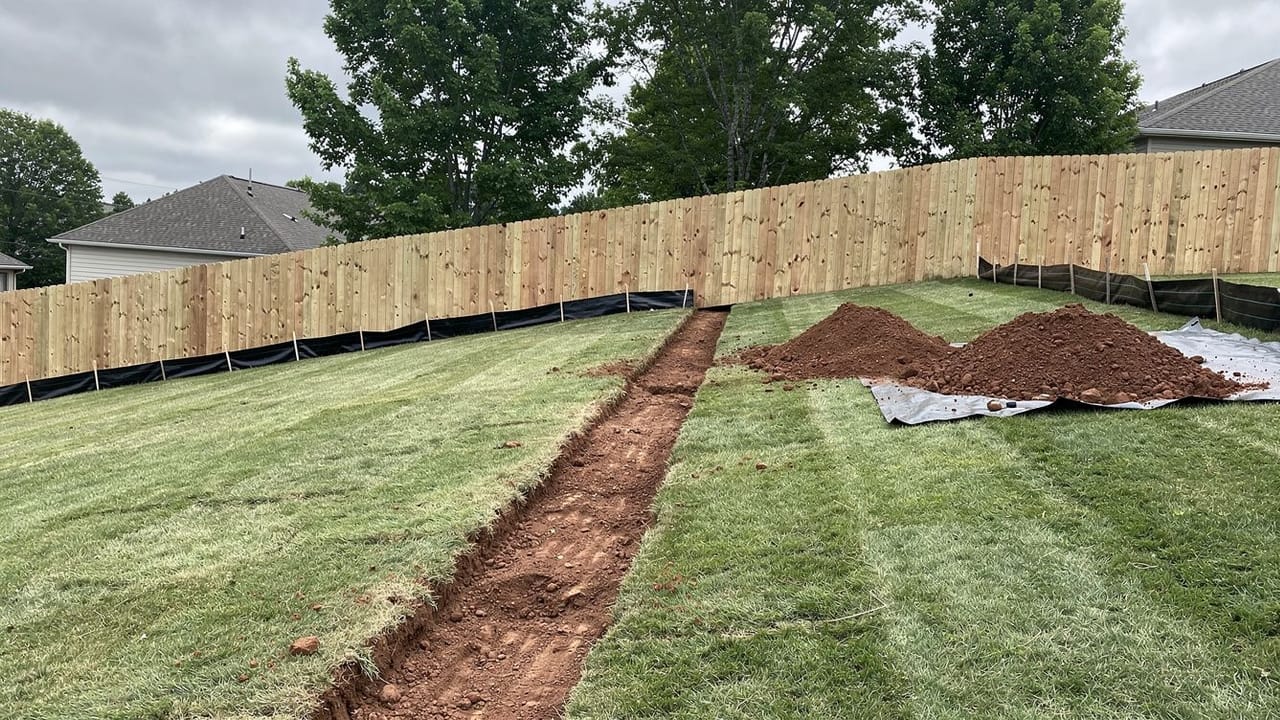
Usually, on a residential lot, because a drain trench is small in volume. A trench a foot wide, two feet deep and a hundred feet long removes about 200 cubic feet of soil, roughly 7.4 cubic yards, far under Metro’s 100 cubic yard line, and its footprint is a small fraction of 10,000 square feet. Metro’s Build Responsibly page does name installing pipes and digging ditches as land-disturbing work, so the trench counts; it just tends to fall under the limits.
Size is not the only test. The trench still has to stay out of the floodplain and out of a sinkhole watershed, and the ground has to be stabilized within 15 days. If the same job reshapes the yard, the 18-inch grade change and the direction of the drainage flow come into play under the landscaping exemption, and a job that turns water toward a different side of the lot is exactly what those terms are written to catch. Where the trench should send the water is covered in our post on what a French drain should be, and the utility locate that comes before any digging is in our post on what to do before excavation starts.
When does a yard drainage job need a stormwater permit?
When it goes past Metro’s limits, when it is in a floodplain, or when it is part of a large enough project to fall under the federal rule. Metro’s Build Responsibly page says any development in a Special Flood Hazard Area needs local permits, not only buildings, that fill placed in the floodplain must be offset by an equal volume of cut taken out of it, and that sites needing a grading permit must preserve water quality buffers along streams, rivers, springs, lakes, ponds and wetlands. The landscaping exemption does not apply in a designated floodplain at all.
The federal threshold is far larger. The EPA’s page on stormwater discharges from construction activities says a Clean Water Act permit is required for construction that disturbs 1 acre or more, or less than an acre if it is part of a common plan of development that will eventually disturb an acre or more. Those permits require erosion and sediment controls and stabilization of disturbed ground when work stops for more than 14 days. State rules may also apply to some sites; we confirm them case by case rather than assume.
Outside Davidson County, the city or county has its own rules, and the numbers here are Metro’s alone. On a Davidson County job, Metro Water Services gives 615-862-7225 for permit questions, and we call when a lot is near a creek, a floodplain or a sinkhole. For drainage work in Nashville or nearby, tell us what the water is doing and we will tell you whether the job looks like it needs a permit before we quote it.
Sources
- Metro Water Services, Who Needs A Grading Permit — Definition of grading; conditions under which no permit is required (100 cubic yards, 10,000 square feet, 15-day stabilization, fill limits, slopes, floodplain, sinkhole or drainage well watershed); landscaping exemption on developed lots (18 inches, drainage direction); exempt work still under erosion control rules.
- Metro Water Services, Build Responsibly to Prevent Flood Damage — Grading permit for land disturbance over 10,000 square feet, including pipes and ditches; local permits for any development in a Special Flood Hazard Area; floodplain fill offset by equal cut; water quality buffers; contact 615-862-7225.
- U.S. EPA, Stormwater Discharges from Construction Activities — Clean Water Act permit for construction disturbing 1 acre or more, or part of a larger common plan; erosion and sediment controls; stabilization when work stops for more than 14 days.
FAQ
Do You Need a Permit to Regrade or Dig for Drainage? — questions
Do you need a permit to regrade your yard in Nashville?
Often not. Metro exempts landscaping on an existing developed lot outside a floodplain when no more than 10,000 square feet is affected at one time, the grade changes 18 inches or less, the drainage keeps its direction, the ground is stabilized within 15 days and 100 cubic yards or less is moved.
How much dirt can you move in Davidson County before you need a grading permit?
Metro’s limit is 100 cubic yards of material removed from, brought onto or disturbed on the lot, alongside the other tests: 10,000 square feet of disturbed ground, stabilization within 15 days, nothing in the floodplain or a sinkhole watershed, and slope limits. A job past any one of them needs a permit.
Does a French drain need a permit in Nashville?
Metro does not name French drains, but it counts installing pipes and digging ditches as land disturbance. A typical drain trench moves far less than 100 cubic yards, so it usually stays under the permit limits, as long as it is outside the floodplain and sinkhole watersheds and does not redirect the lot’s drainage.
Who issues the grading permit in Davidson County?
Metro Water Services. Its Stormwater Division issues grading permits for land-disturbing activity in Metro Nashville and Davidson County, under Volume 1 of Metro’s Stormwater Management Manual. Metro Water Services gives 615-862-7225 for questions about whether a job needs one. Other counties and cities have their own offices.
Do you need a permit to dig in a floodplain?
In Davidson County, yes, in practice. Metro says any development in a Special Flood Hazard Area needs local permits, the landscaping exemption does not apply in a designated floodplain, and any fill placed in the floodplain must be balanced by an equal volume of cut removed from it.