
· by Michael Blair, Nashville's Drainage and Excavation
Most of the digging behind a drainage fix happens in a trench: a run of pipe for a French drain, a line from a downspout to daylight, a new water or electrical feed to an outbuilding. A trench looks like the least dramatic part of the job, and it is the part where a wall of wet clay can fold in on whoever is standing at the bottom. The federal excavation rules spell out when a trench needs protection, what the soil has to be checked for, and what has to be kept away from the edge. Those rules are written for the people doing the work, but they also hand a homeowner a clear way to judge a crew before it starts. Here is how they apply to the excavation and trenching work we do across Middle Tennessee, and what to ask whoever you hire.
The 5-foot line, and why it is not a free pass
The rule people quote is that a trench under 5 feet deep does not need shoring. That is close, but it leaves out the condition attached to it. Under OSHA’s protective systems standard, 29 CFR 1926.652, every worker in an excavation has to be protected from cave-ins by an adequate system. There are two exceptions: an excavation cut entirely in stable rock, and one less than 5 feet deep where a competent person has examined the ground and found no sign of a potential cave-in. The shallow exception depends on someone actually looking. A 4-foot trench in soft, wet or previously dug ground can still need protection.
When protection is needed, there are a few ways to provide it. The walls can be sloped back, shored with supports, or the crew can work inside a trench box that shields them if the wall moves. Where nothing better has been worked out for the soil, the same standard sets a default slope of 1.5 feet horizontal for every 1 foot of depth, about 34 degrees. That is a wide cut. A trench that is 5 feet deep sloped that way opens up to more than 15 feet across at the top, which on a residential lot can mean taking out a fence section, a bed, or the lawn along a whole side of the house. Knowing that number ahead of time explains why a crew might bring a trench box instead, and why the plan for a deep run should be settled before anyone digs.
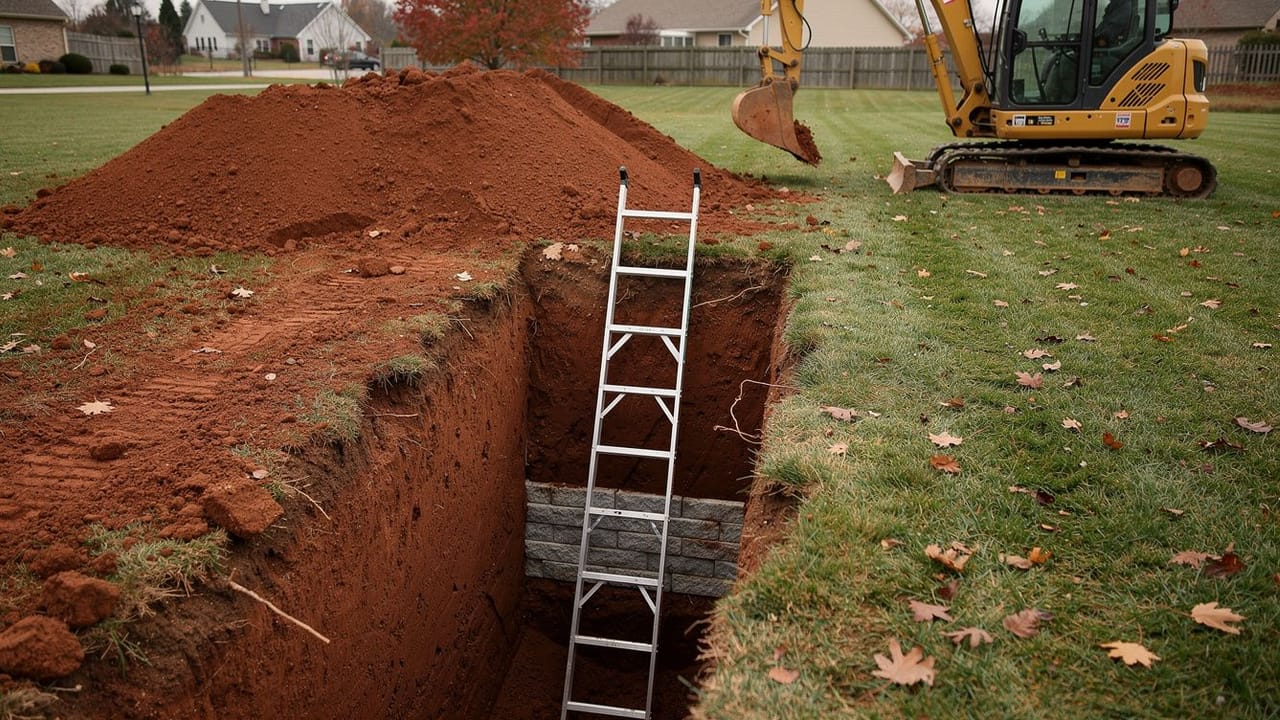
Depth adds other duties. The OSHA excavation requirements, 29 CFR 1926.651, call for a ladder, stairway or ramp in any trench 4 feet deep or more, placed so no one has to travel more than 25 feet sideways to reach it. If a crew is working 4 feet down and the only way out is to climb the wall, that is a problem you can see from the patio.
What Middle Tennessee clay does to the answer
How much protection a trench needs depends on the soil, and OSHA sorts soil into three types. Under Appendix A to Subpart P, clay, silty clay and clay loam can rate as Type A, the most stable class, when they test strong enough. The catch is what knocks a soil out of that class. Clay that is fissured, that has been dug before, or that is subject to vibration drops to Type B. Soil that is submerged or has water seeping freely out of the walls is Type C, the least stable class, whatever it started as.
That list reads like a description of a typical drainage job here. The clay around a house has often been dug before, for the foundation, the sewer lateral, the water service or an old drain line, and backfilled ground counts as previously disturbed. Clay that bakes through a dry summer opens cracks that the appendix treats as fissures. And a drainage trench is usually being dug because water is in the ground, so seepage from the walls is exactly what to expect. Underneath, much of the region has limestone at shallow and uneven depths, so one end of a run may be in deep clay and the other end on rock. The appendix also says soil should be classified again after it is exposed to rain or flooding. The trench that was sound on Tuesday is not assumed sound after a Wednesday storm.
The appendix describes field tests a competent person can use, among them rolling a thread of soil about an eighth of an inch thick to see whether it holds together for 2 inches, pressing a thumb into the wall, and drying a sample to see whether it cracks. You do not need to run them yourself. What matters is that someone on the crew knows them and can tell you what class the ground is and what the crew is doing about it.
Water, spoil and the daily inspection
Water in a trench is its own hazard. Section 1926.651 says no one works in an excavation where water has collected or is collecting unless precautions are in place, such as support or shielding, pumping the water out, or a harness and lifeline. Pumps used to keep the trench dry have to be watched by a competent person. And if the trench cuts across the way surface water naturally drains, the crew should divert it with a ditch or a berm so the next rain does not run straight into the hole. On a sloped lot, a trench laid across the hill for a French drain is doing exactly that, so this is not an edge case for us.
The pile of dug soil matters too. The same section requires excavated material and equipment to sit at least 2 feet back from the edge, held so it cannot roll in, or both. Soil heaped right at the lip of a trench pushes on the wall below it and can slide back in on its own. A clean job has the spoil set back and the machine parked away from the cut when it is not digging.
Last, a competent person has to inspect the trench every day before work starts, again as conditions call for it, and after every rainstorm or anything else that makes a cave-in more likely. In Tennessee, construction safety is enforced by TOSHA, the Tennessee Department of Labor’s occupational safety program, which also publishes company inspection history and penalties, so a contractor’s record can be looked up.
Five questions to ask before a crew opens a trench
Whether the job is a drain line in Franklin and the rest of Williamson County or a utility run in Davidson County, the questions are the same, and a good crew answers them without hesitating. Ask who the competent person on site will be, by name. Ask how deep the trench will go at its deepest point and what will hold the walls if it goes past 5 feet, or if the ground turns out to be wet or previously dug. Ask where the spoil pile and the machine will sit. Ask what happens if a storm fills the trench overnight: who checks it, and what gets done before anyone climbs back in. And ask whether the locate ticket is in the contractor’s own name and still current.
That last one comes before any of the others. The Tennessee 811 FAQ says anyone who digs, including by hand, has to give at least three working days’ notice, and the ticket stays valid for 15 calendar days after the legal start date. We cover the locate process in more detail in what to do before any excavation starts, and the depth, slope and gravel a drain needs in what a French drain should actually be.
None of this is meant to make a backyard trench sound like a highway cut. Most of the drain and utility lines we lay never reach a depth where the walls need anything more than a careful look. But the ones that do are hard to tell apart from the ones that do not until someone checks the soil, the water and the depth, and that check is the job. If you have a drain, a line or a site prep job in mind, ask us for a free estimate and we will walk the route with you and tell you how deep it needs to go.
Sources
- OSHA, 29 CFR 1926.652 Requirements for protective systems — Cave-in protection required except in stable rock or under 5 feet with a competent person’s examination; default slope of 1.5 horizontal to 1 vertical.
- OSHA, 29 CFR 1926.651 Specific excavation requirements — Exit within 25 feet in trenches 4 feet deep or more; water precautions; spoil and equipment 2 feet from the edge; daily and after-rain inspection by a competent person.
- OSHA, 29 CFR 1926 Subpart P Appendix A, Soil Classification — Soil Types A, B and C; fissured, disturbed or vibrated clay is downgraded; seeping or submerged soil is Type C; field tests; reclassify after rain.
- TOSHA, Tennessee Department of Labor and Workforce Development — Enforces construction safety and health standards in Tennessee and publishes company inspection history.
- Tennessee 811, Frequently Asked Questions — At least three working days’ notice before any digging, including by hand; ticket valid 15 calendar days after the legal start date.