
· by Michael Blair, Nashville's Drainage and Excavation
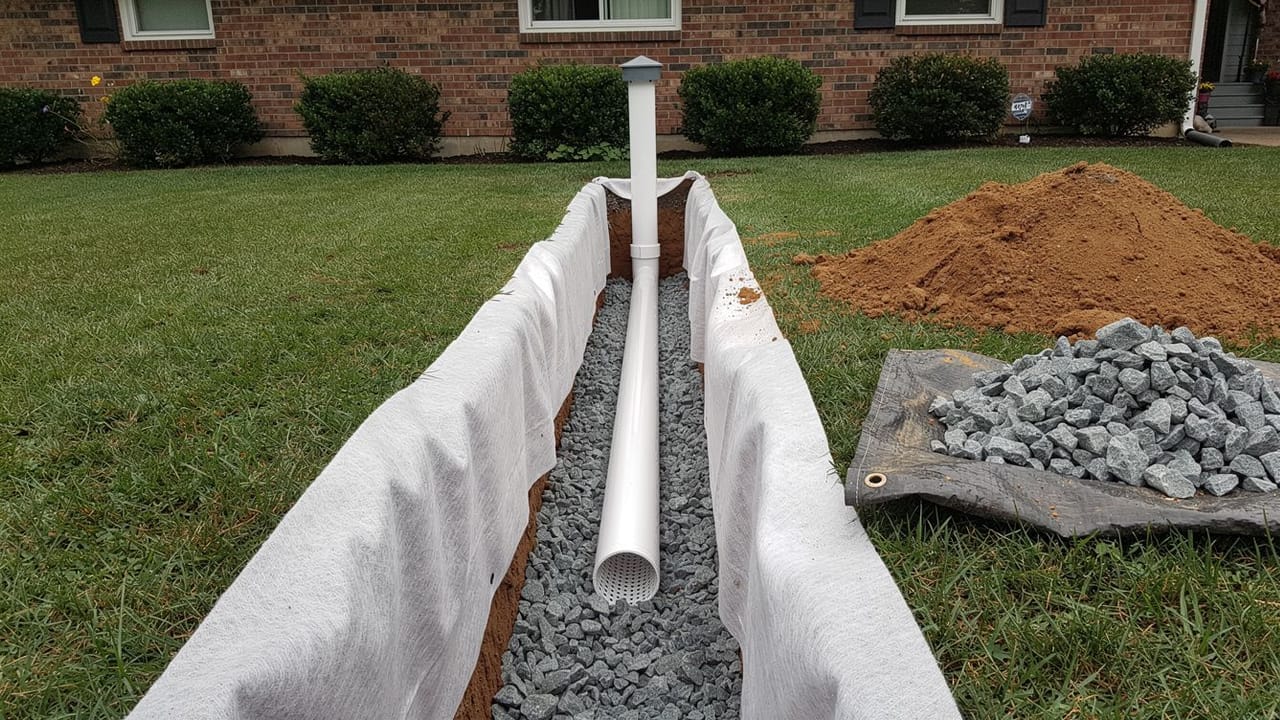
A French drain is a gravel-filled trench with a perforated pipe, collecting subsurface water and carrying it somewhere lower. WSU Extension’s page on improving drainage describes them as shallow trenches lined with geotextile fabric or weed cloth, with a perforated plastic pipe set in gravel. Each element has a specification, and skipping one can shorten the drain’s life. A drain also has limits: the UT Extension Master Gardener handbook’s chapter on soil management says drain lines only work when the water table is above them, and that in fine-textured soils water can move too slowly toward a drain tile for it to help. Those parts are what we price and build in our French drain service, and most of them are out of sight once the trench is closed.
What gravel should go in a French drain?
The stone is there to hold open space for water, so the first thing that matters is that it is clean. Metro Nashville’s stormwater manual specification for permeable pavement calls for #8 or #89 clean washed stone in the bedding and #57 or #2 clean washed stone in the reservoir layer, and the City of Memphis underdrain specification limits how much fine material may pass its smallest sieves. Those limits keep dust and fines out of the gaps the water is meant to travel through.
We use washed, angular crushed stone and look at what comes off the truck before it goes in a trench. That is our preference. The Memphis specification accepts crushed stone or washed gravel, as long as it meets the ASTM D692 quality standard, and what it does not accept is stone with the fines still in it.
Why does a French drain need filter fabric?
Fabric separates the gravel from the surrounding soil so silt does not migrate in and fill the voids. WSU Extension says the cloth keeps soil from filling the spaces between the gravel, which keeps water flowing through it. Advanced Drainage Systems’ installation guide for its N-12 drainage pipe warns that moving water can carry sand or silt into a drain and block it or reduce its capacity, and calls for non-woven filter fabric where soil migration is a concern. The stone does some of that work on its own; a 1980 Bureau of Reclamation lab paper on gravel envelopes describes a graded gravel envelope as keeping excessive base soil from moving into the drain. We wrap every French drain we build anyway.
It should wrap the whole gravel envelope rather than only lining the trench bottom. In the Memphis specification the cloth is laid in the trench, the gravel placed, and the cloth closed over the top with at least 10 inches of overlap held with mechanical ties. WSU’s version is the same idea for a yard: the cloth is folded over the top of the gravel and then covered with soil.
- Clean washed stone with few fines
- Geotextile wrapping the whole gravel envelope
- Perforations down, contrary to intuition
- Continuous fall to a daylight outfall
- Cleanouts so it can be maintained
Perforations face down
It sounds backwards. The Memphis specification says perforated pipe is laid with the perforations at the bottom, and Contech’s guide to its strip-perforated steel pipe recommends perforations down for general subdrainage work. Contech gives two reasons: holes facing down help keep out solids that could clog the line, and they let the drain pull the water table lower.
There is one exception worth knowing. Contech allows the holes to face up on a stretch of pipe that only carries water away instead of collecting it, and the Memphis specification uses solid, non-perforated pipe for the line that leads from the drain to its point of discharge.
The outfall
Continuous fall to somewhere lower, daylighting where water can leave. TDOT’s standard drawing for underdrains is written for roadways, but it sets a minimum slope of 0.5 percent for the flow line, and WSU Extension recommends sloping a drain trench between 0.5 and 1 percent, a foot of drop over 100 feet at the steeper end. Where the pipe comes out at grade, Memphis covers the end with a wire screen of half-inch openings. A drain that empties into a low spot with nowhere to go can leave the water standing there instead, and our post on where water should go on a Nashville lot is about choosing that spot.
Cleanouts at the ends let it be flushed and inspected. The Metro permeable pavement specification puts a 6-inch PVC cleanout with a vented cap at the upper end of an underdrain, and Contech notes that inspection risers usually go wherever the line changes direction. We put cleanouts in both places on the drains we build. If there is water on your lot that needs somewhere to go, ask us for a free estimate.
Sources
- City of Memphis, Standard Construction Specifications, Section 02620 Underdrains (2005) — Crushed stone or washed gravel meeting ASTM D692; fines limits; fabric closed over the top with 10-inch overlap; perforations at the bottom; non-perforated lateral to the point of discharge; half-inch wire screen at an at-grade outlet
- Metro Nashville Stormwater Management Manual Vol. 5, GIP-03 Permeable Pavement (2021) — Clean washed stone (#8/#89 bedding, #57/#2 reservoir); 6-inch PVC cleanout with vented cap at the upper end of the underdrain
- Tennessee Department of Transportation, Standard Drawing RD-UD-3 Underdrain Details — Minimum 0.50 percent slope for the underdrain flow line (roadway context)
- Contech Engineered Solutions, HEL-COR Strip-Perforated Pipe — Perforations down for general subdrainage, to keep out solids and lower the water table; holes up allowed where the line only conducts water; risers at changes of direction
- Advanced Drainage Systems, N-12 HDPE Pipe Installation for Agricultural Drainage (IG1.03PE, 2022) — Water can move sand or silt into a drain; non-woven filter fabric where soil migration is a concern
- Washington State University Extension (Clark County), Improving Drainage — French drain build; cloth keeps soil out of the gravel and is wrapped over the top; trench sloped 0.5 to 1 percent
- UT Extension Master Gardener Handbook, Chapter 6: Soil Management in Residential Gardens and Landscapes — Drain lines work only when the water table is above them; in fine-textured soils water moves too slowly to drain tiles for them to help
- US Bureau of Reclamation, Laboratory Tests of Gravel Envelope Flow Resistance (PAP-395, 1980) — A graded gravel envelope prevents excessive movement of base soil into the drain
FAQ
What a French Drain Should Actually Be — questions
Should French drain pipe have holes facing up or down?
Down. It sounds backwards, but the Memphis underdrain specification and Contech’s pipe guide both call for the perforations at the bottom of a collecting drain. Contech says holes facing down help keep out solids that could clog the line and let the drain lower the water table further. Holes up is acceptable only on a stretch that carries water without collecting it.
Why do French drains stop working?
Silt is the one the guides warn about: ADS says moving water can carry sand or silt into a drain and block it, and WSU Extension says the fabric is what keeps soil out of the gaps in the gravel. Stone with fines in it, too little fall, or an outlet with nowhere to go can each keep a drain from doing its job. Some ground is poor for any drain, and UT Extension’s Master Gardener handbook notes that in fine-textured soils water moves too slowly toward drain tiles for them to help.
Do I need cleanouts on a French drain?
We recommend them. A drain that can be flushed can be maintained. Metro Nashville’s permeable pavement specification puts a cleanout at the upper end of the underdrain, and Contech places inspection risers wherever the line changes direction, so those are the places we put them. Adding one later means digging down to the pipe to fit it.
Do French drains really work?
They do where the water table rises above the pipe and there is lower ground for the outlet. UT Extension’s Master Gardener handbook says drain lines only work when the water sits above them, and that in fine-textured soils water can move too slowly toward one to help. Clean stone, fabric and steady fall keep a good one working.