
· by Michael Blair, Nashville's Drainage and Excavation
Excavation is the point at which mistakes become dangerous rather than expensive. A few steps beforehand lower the risk a great deal, and they are the first things we arrange on any excavation or site work job in Davidson County and the counties around it.
Who has to call 811 before digging?
Under Tennessee’s Underground Utility Damage Prevention Act, nobody may excavate in a street, a public space, a utility’s private easement or within 100 feet of the edge of the pavement without notifying the one-call center first. The Act exempts a property owner digging with hand tools on their own property; it does not exempt a machine or a hired contractor, and we put in a ticket on every job we dig. The Tennessee Public Utility Commission says there is no charge for a locate request, which has to go in at least three working days, and no more than ten, before the digging starts.
The marks stop where the public system does. Tennessee 811’s page on public and private utilities says electric and gas lines are typically marked only up to the meter, and that the property owner is responsible for having private lines located: power or gas run on to a pool heater or a grill, irrigation, lines to a septic system, landscape lighting and invisible pet fences. The same page lists private locating companies working in Middle Tennessee.
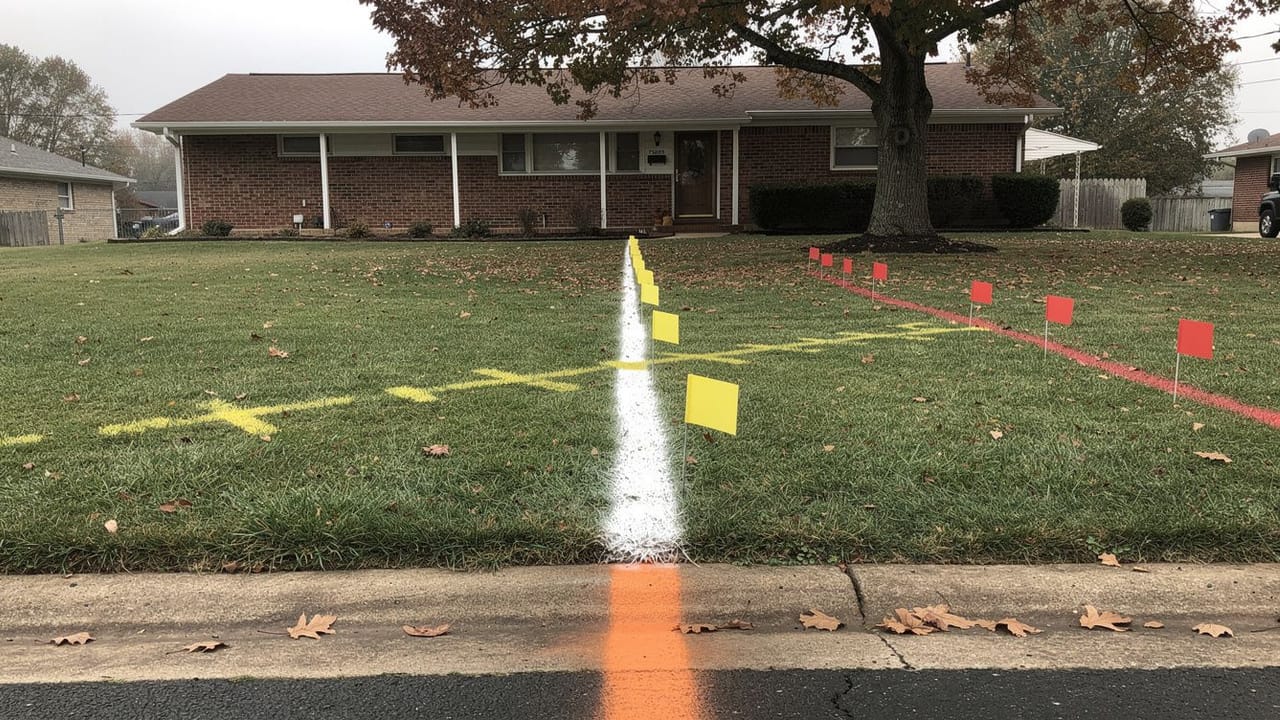
What do the 811 paint colors mean?
The paint and flags follow the uniform color code on Tennessee 811’s quick links page: yellow for gas, oil and steam, red for electric power, blue for drinking water, green for sewer and drain lines, and orange for communications. White is the proposed dig area, pink is temporary survey marking, and purple is reclaimed water and irrigation.
A mark shows an approximate position. Tennessee 811’s steps to safe digging put the tolerance zone at the width of the line plus 2 feet on each side, note that utilities do not have to give depth, and say the best way to pinpoint a line is to expose it carefully. Inside that zone the Act calls for reasonable care, by hand digging where practical, pneumatic hand tools, or a method the utility approves, and that is how we work around every mark before a machine goes near it.
- Put in a locate ticket at least three working days ahead, and no more than ten
- Private lines are not marked — have your own located
- Dig with care inside the line’s width plus 2 feet each side
- Check Metro’s grading permit limits before starting
- Know where the spoil is going before you dig
Permits and rules
In Davidson County the grading permit is the one digging most often runs into. Metro Water Services’ page on who needs a grading permit exempts maintenance and landscaping grading only while the grade changes no more than 18 inches at any point, the direction the water drains stays the same, the area stays under 10,000 square feet and the material stays under 100 cubic yards, and none of that applies in a designated floodplain. Excavation for a house’s basement and footings, and for retaining walls, is exempt from the grading permit itself, which is where regrading a yard and building a wall part ways.
A wall can still need a building permit. Metro adopted the 2024 International Building Codes in 2025 for all building and trades work permitted in Davidson County, so before we design one of our retaining walls we confirm its height and what it holds back with Metro Codes. Easements are the other trap: the Act names a utility’s private easement as a place where notice is always required, so check the plat or deed for recorded easements before planning anything permanent across one.
Where the soil goes
Every trench and footing leaves a pile, and if it stays on the lot Metro counts it. The same grading page takes a job out of the exemption once more than 100 cubic yards is removed from, deposited on or disturbed on a lot, or once fill reaches five feet deep or sits in the 100-year floodplain.
Plan for a truck or a place to put it before starting, or the project stalls with a large pile in the middle of the yard. Where the pile sits matters for an open trench too, which our post on what to ask a trenching contractor about safety covers. If you want the ticket, the permit question and the spoil handled together, ask us for a free estimate.
Sources
- Tennessee Underground Utility Damage Prevention Act, Tenn. Code Ann. 65-31-101 et seq. (TPUC copy) — Notice required within 100 feet of the pavement, in public spaces and operator easements; homeowner hand-tool exemption; fence post exclusion; reasonable care in the safety zone
- Tennessee Public Utility Commission, Underground Utility Damage Prevention — No charge for a locate request; at least three and no more than ten working days’ notice
- Tennessee 811, Public and Private Utilities (Private Locating Info) — Private lines not marked; electric and gas marked to the meter; owner responsible; list of private locators
- Tennessee 811, Quick Links (uniform color code) — Mark colors for gas, electric, water, sewer, communications, proposed excavation, survey and reclaimed water
- Tennessee 811, Homeowners: Steps to Safe Digging — Tolerance zone of the line’s width plus 2 feet each side; locating not exact; no depth given; expose the line
- Metro Water Services, Who Needs a Grading Permit (updated October 24, 2025) — Grading exemptions: 18 inches, drainage direction, 10,000 square feet, 100 cubic yards, floodplain, fill depth; footings and retaining walls exempt
- Metro Codes, Metro Adopts 2024 International Building Codes (July 23, 2025) — 2024 International Codes adopted for all building and trades work permitted in Davidson County
FAQ
What to Do Before Any Excavation Starts — questions
Do I really need to call 811 for a small job?
It depends on who is digging and where. Tennessee law exempts a property owner digging with hand tools on their own property, but a machine or a hired contractor has no such exemption. Fence post holes are left out of the law only on private land more than 100 feet from the edge of the pavement and outside a utility easement. The request is free and a locate ticket greatly lowers the risk of hitting a public line, so we suggest it for any digging. Allow at least three working days.
Does 811 mark private utility lines?
No. Utility operators may not locate or mark private lines, and electric and gas service is typically marked only up to the meter. Power or gas run on to a pool heater or a grill, irrigation piping, lines to a septic system, landscape lighting and invisible pet fences are the property owner’s to have located. Tennessee 811 keeps a list of private locating companies that can do it.
How close can I dig to a marked line?
Tennessee law sets the tolerance zone at the width of the line plus 2 feet on each side of the marks. Inside it, dig with reasonable care: by hand where practical, with pneumatic hand tools, or by a method the utility approves, and expose the line to confirm where it is. The zone exists because locating is not exact, and the marks do not tell you the depth.
Is calling 811 free?
Yes. The Tennessee Public Utility Commission says a locate request costs nothing. The ticket has to go in at least three working days and no more than ten before the dig, and the marks cover public lines only up to the meter, so private lines such as irrigation or landscape lighting need a locator you hire.