
· by Michael Blair, Nashville's Drainage and Excavation
A catch basin is a box set at a low point with a grate on top and a pipe leaving through the side. The part below that pipe, the sump, is meant to fill with silt, leaves and grit so the pipe beyond it stays clear. That works for a while and then quietly stops. Water still goes in the top and still comes out the pipe, but it now carries the dirt the basin was supposed to keep, and the line downstream starts to fill instead. Most owners only find out when water stands on the grate after a storm. Here is how we judge when the catch basin on a Middle Tennessee lot needs cleaning, whose job it is, and what happens to what comes out of it.
How full can a catch basin get before it needs cleaning?
Clean it once the deposits reach about half the depth between the floor of the basin and the bottom of the lowest pipe leaving it. That threshold comes from the 2004 Connecticut Stormwater Quality Manual, chapter 11 on catch basins, published by Connecticut’s Department of Energy and Environmental Protection, which cites the EPA for it. It is Connecticut’s design guidance, written for larger paved drainage areas, and not a Tennessee rule, but the reasoning carries to a yard basin. The same manual says studies show a basin captures sediment up to roughly 50 percent of its sump volume and then reaches a steady state, because a storm stirs the settled material back up and sends it out the pipe.
Past half full, then, the basin is no longer catching anything. Each heavy rain flushes part of the sump into the line, and the line is the expensive part to clear. The manual adds that a basin found well over half full at its yearly check should be cleaned more often, and that one on a flat grade or a slow flow rarely flushes itself.
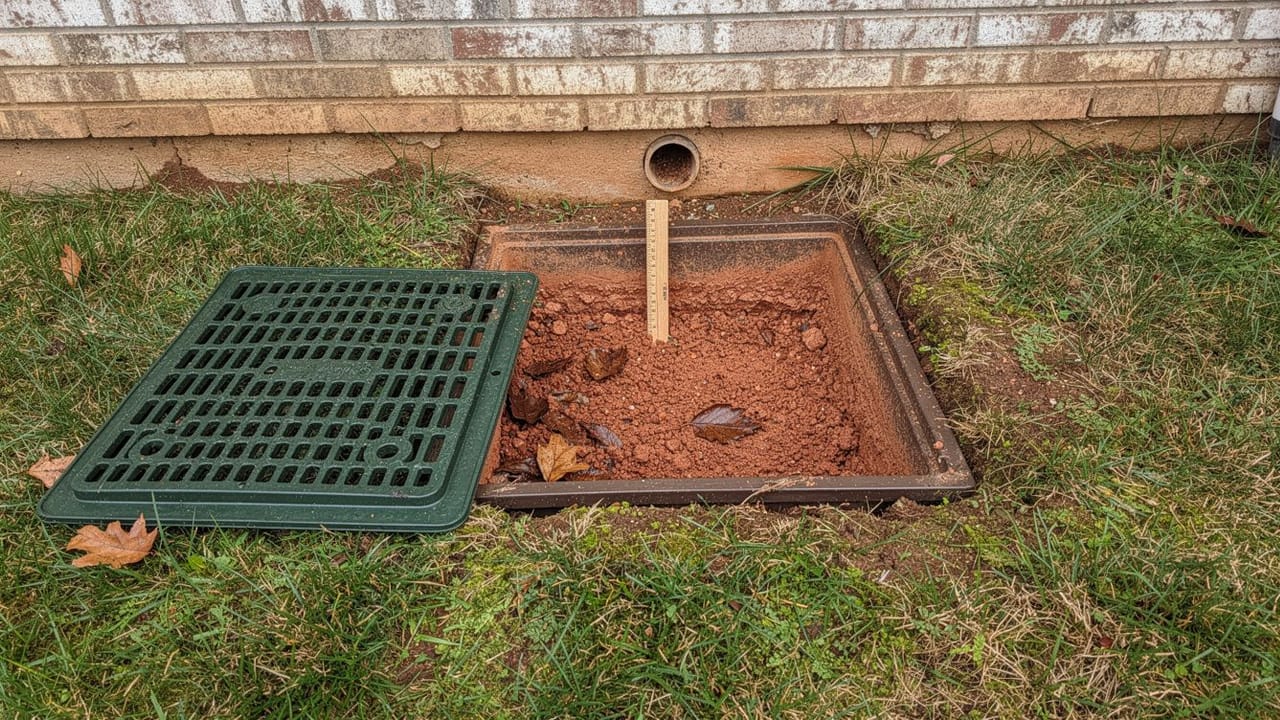
You can check it yourself with a yardstick. Lift the grate, push the stick down until it stops on the soft top of the sediment and note the mark, then push through to the hard floor and note that. The difference is the depth of the deposits. Measure from the floor up to the bottom edge of the outlet pipe opening for the sump depth, and compare the two. The water sitting in the box below the pipe is normal; a sump is built to hold water. Water standing above the outlet pipe a day after the rain has stopped means the pipe itself is blocked, which is a different problem from a full sump.
Is the catch basin mine to clean or Metro’s?
A basin on your property that collects your own roof and yard water is yours to maintain, and the inlets in the street are Metro’s. The Metro Water Services stormwater maintenance page lists what Metro manages: flooding to the public roadway, roadside ditches and driveway pipes, drains under the roadway and clogged storm drains. It states that property owners are responsible for managing and maintaining stormwater issues affecting their private property, and it puts runoff from one private property onto another in the owner’s column too.
In practice the line falls at the street. A grate in the curb or a pipe under the road that backs up is something to report to Metro through hubNashville or by dialing 311, or to Metro Water Services at 615-862-4600. The basin in your side yard, the one under a downspout, and the box at the bottom of the driveway that feeds your own pipe are yours. If the property has a stormwater control measure recorded with it, such as a bioretention area, Metro’s bioretention maintenance page says the owner inspects and maintains it, including keeping its inlets and outlet free of sediment, trash and plant growth, and that the maintenance requirements are filed with the property deed. Outside Davidson County the city or county runs its own stormwater program, and each of our city pages, such as drainage work in Franklin, names the local permit office.
Where can the sediment from a catch basin go?
Not into a street drain, a ditch or the gutter along the curb. Metro Code 15.64.205, posted on Metro Water Services’ Illicit Discharge Ordinance page, declares non-stormwater discharges into the municipal storm sewer system prohibited and unlawful, and it defines that system to include catch basins, curbs, gutters, ditches, man-made channels and storm drains. Hosing a sump’s worth of silt and rotted leaves down the driveway into the curb inlet is exactly that kind of discharge.
It also does not help. Metro’s pollution prevention page warns that debris left in a ditch or on a storm drain will act like a dam, and it sums up the rule as only rain belongs in the drain. Washing the sediment down your own outlet pipe is no better, since it just moves the pile from a box you can reach into a pipe you cannot. What comes out of the sump goes into bags or a bucket and leaves the site with us, and we keep it off the lawn anywhere the next rain could carry it back to the grate.
How we clean a yard catch basin and keep it from refilling
We pull the grate and clear the trash caught on it first, then take the sediment out of the sump. The Connecticut manual names a vacuum truck for that, which suits the large basins it was written for; a small yard box comes clean with a scoop and a wet vacuum. With the sump empty, we run water into the basin and watch it leave through the outlet. If it backs up, the trouble is in the pipe, and a buried downspout line that stops draining covers how we find a clog or a sag in one.
A basin that fills again within a season is telling you about what drains into it. Grit off the roof comes down the downspout drainage into any box under it, and clay silt washing off bare or freshly graded ground fills a sump faster than leaves off a lawn. Covering the bare soil or regrading the slope above it does more than cleaning the box more often. Depth matters as well: the manual calls for a sump at least four times the diameter of the outlet pipe, deeper where cleaning will be infrequent or the sediment load is heavy, and many of the shallow boxes we lift out of yards are far short of that. When a basin keeps filling for that reason, we replace it with one of the catch basins we install, sized to that rule.
For a basin at the foot of a driveway, our post on channel drains and catch basins for a driveway covers how that drain should be built. If your basin is holding water above the pipe, filling fast or sitting somewhere you cannot open, ask us to look at it and we will measure the sump, check the outlet and tell you in writing what it needs.
Sources
- Connecticut DEEP, 2004 Connecticut Stormwater Quality Manual, Chapter 11, S-3 Catch Basins — Connecticut design guidance, not a Tennessee rule: clean when deposits reach half the depth to the lowest pipe invert (citing EPA, 1999); sediment capture up to about 50 percent of sump volume before re-suspension; sump at least four times the outlet diameter; vacuum-truck sediment removal.
- Metro Water Services, Stormwater Maintenance — What Metro manages (roadside ditches and driveway pipes, drains under the roadway, clogged storm drains) and that property owners are responsible for stormwater issues on their private property; contact 615-862-4600.
- Metro Water Services, Illicit Discharge Ordinance (Metro Code 15.64.205) — Non-stormwater discharges into the municipal storm sewer system are prohibited and unlawful; the system includes catch basins, curbs, gutters, ditches, man-made channels and storm drains.
- Metro Water Services, Pollution Prevention — Debris left in a ditch or on a storm drain acts like a dam; only rain belongs in the drain.
- Metro Water Services, Bioretention — Owners inspect and maintain stormwater control measures on their property, keep inlets and outlets free of sediment, and the maintenance requirements are filed with the deed.
FAQ
Catch Basin Cleaning: When the Sump Is Full — questions
How do I know when my catch basin is full enough to clean?
Measure the sediment with a yardstick and compare it to the depth from the basin floor to the bottom of the outlet pipe. Once the deposits reach about half that depth, the threshold in Connecticut’s stormwater design manual, the basin has stopped catching more and storms begin pushing silt out into the pipe.
Who is responsible for cleaning a catch basin, the city or the homeowner?
In Davidson County, Metro Water Services manages roadside ditches, driveway pipes, drains under the roadway and clogged storm drains. Property owners are responsible for stormwater issues on their own property, so a basin in your yard that collects your roof or lawn water is yours to keep clean, while a curb inlet is Metro’s.
Can I wash the sediment down the storm drain?
No. Metro Code 15.64.205 makes non-stormwater discharges into the storm sewer system unlawful, and the ordinance counts catch basins, curbs, gutters, ditches and storm drains as part of that system. The silt and leaves from a sump should be bagged and hauled away, not rinsed into the street or down your own outlet pipe.
What is the sump in a catch basin for?
The sump is the space below the outlet pipe. Water slows down there, so silt, grit and leaves settle out before the water leaves through the pipe. Connecticut’s design manual calls for a sump at least four times the outlet pipe’s diameter, because a shallow sump fills fast and lets sediment through into the line.
Why is my catch basin full of standing water?
Some standing water is normal, because the sump sits below the outlet pipe and holds water between storms. Water that stays above the bottom of the outlet pipe a day after the rain stops is different. It usually means the outlet pipe is clogged, crushed or sagging somewhere downstream, and the line needs checking.