
· by Michael Blair, Nashville's Drainage and Excavation
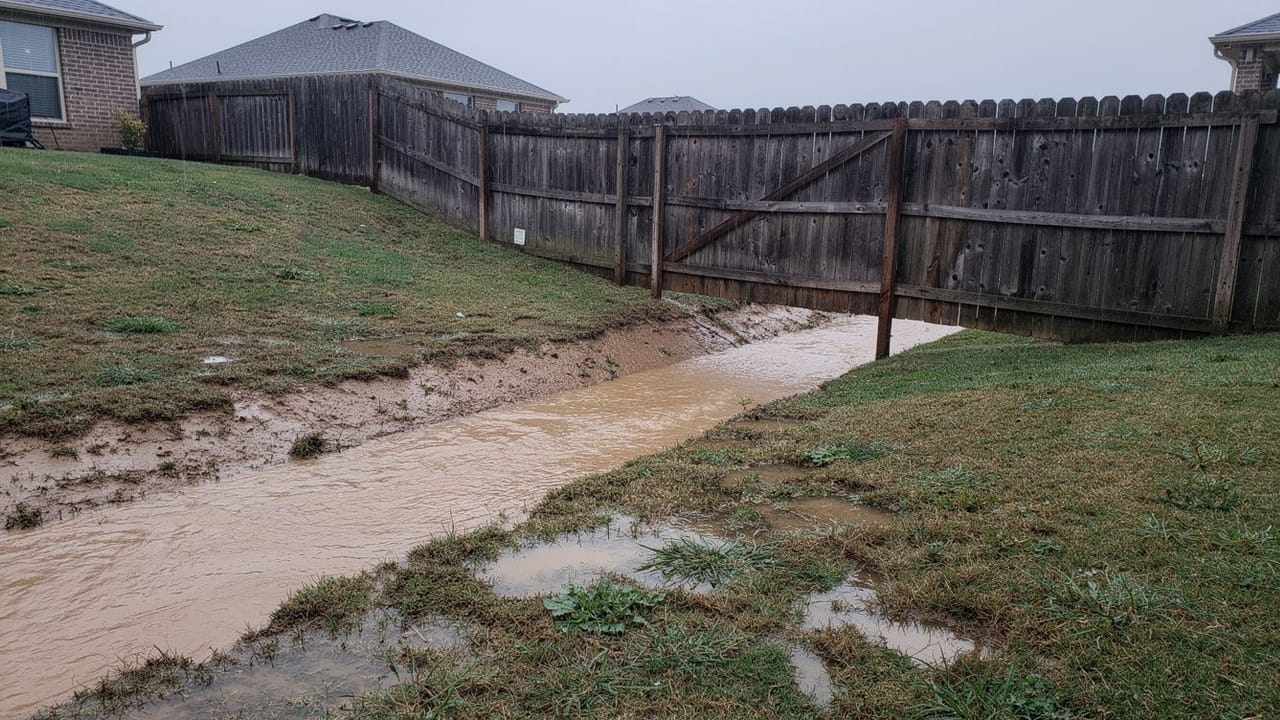
Water from the yard next door is one of the most common reasons people call us after a hard rain, and the first question is usually not how to fix it but whose problem it is. Tennessee courts have answered that for decades with the natural flow rule. We are not lawyers, and nothing here is legal advice; what follows is how the University of Tennessee’s Municipal Technical Advisory Service (MTAS), which advises Tennessee cities, summarizes the rule, what Metro says it will and will not do, and how we design yard grading and drains so the fix itself does not start a new dispute.
Can my neighbor’s rainwater legally drain onto my yard in Tennessee?
Rainwater from a neighbor’s yard can usually drain onto yours in Tennessee when it is the water that would run there naturally, according to MTAS. A 2025 MTAS presentation on drainage law and local government states that Tennessee is governed by the natural flow rule, under which water has a natural easement along the paths it follows. Owners above and below both have to accept the water that flows, or would have flowed, onto their land.
MTAS contrasts that with the “common enemy” doctrine, where each owner fights off surface water however they can. An older MTAS paper on drainage liability in Tennessee case law quotes a 1938 Tennessee appeals decision saying that doctrine does not apply here. So the lower yard on a slope is expected to take some water from the higher one. What the rule limits is what either owner does to change it.
What the natural flow rule does not allow
The natural flow rule, as the 2025 MTAS presentation puts it, generally keeps a landowner from doing three things: blocking the natural flow, adding to its natural volume, or speeding it up. The rule cuts both ways. The owner below cannot dam the water back onto the yard above, and the owner above cannot gather it and send it downhill in one concentrated stream.
The 2004 MTAS paper summarizes Tennessee appeals cases that show what that looks like on the ground. In one, the owner of the higher lot was held responsible for altering the natural flow and discharging it below in concentrated form and unnatural amounts. In another, a court ordered the lower owners to take out a dam, and barred the higher owners from piling grass clippings, pine needles and other yard waste against a chain-link fence in a way that channeled the water. A paper summary is not the court opinion, and whether a given yard crosses the line is a question for a lawyer, not for us.
Will Metro Water Services fix runoff between two private yards?
Metro Water Services does not fix runoff between two private yards. Its stormwater maintenance page puts water flowing from one privately owned lot onto another on its list of services Metro does not provide, alongside groundwater, underground springs and flooding from being in a floodplain, and it says owners are responsible for stormwater problems on their own property. What Metro does handle is the public system: roadside ditches and the pipes under driveways, drains under the street, clogged storm drains and flooding of the roadway itself. Our post on driveway culverts and ditches covers where that line falls at the front of a lot.
The 2025 MTAS presentation describes the same limit for Tennessee cities in general: a city usually has no responsibility for drainage problems among private owners unless it broke the natural flow rule itself. MTAS notes one exception. When an owner caused the problem by violating subdivision regulations, a stormwater ordinance or another law, the city can treat it as a compliance matter. Between two yards in Nashville, then, the fix starts with the owners themselves.
How do you redirect runoff without sending it onto the next yard?
Redirecting runoff without sending it onto the next yard means moving water across your own lot and letting it leave close to where, and close to how, it left before. That is the test we design every drainage job against, because the three limits MTAS describes are exactly the ways a careless fix goes wrong: a berm that holds water back on the uphill neighbor, a pipe that dumps a whole roof into one corner of the downhill neighbor’s yard, or a swale cut so steep it sends water across the property line faster than it ever ran.
In practice that usually means catching the water where it does harm, near the house or in a low spot, and carrying it in a French drain or through a catch basin to a place on your own lot where it can spread out and slow down before it crosses the line.
Our post on where water should go on a Nashville lot walks through the options, and the one on grading and drainage permits in Davidson County covers when Metro has to sign off first. If the water is coming from next door, ask us to look at the yard after the next rain, and we will show you where it is entering and what can be done on your side of the line.
Sources
- Metro Water Services, Stormwater Maintenance — Runoff from one private property to another, groundwater, springs and floodplain flooding are not managed by Metro; owners are responsible for stormwater on their property; Metro handles roadside ditches, driveway pipes, street drains and roadway flooding
- MTAS (University of Tennessee), Drainage Law and the Responsibility of the Design Engineer/Local Government, John Chlarson (2025) — Tennessee follows the natural flow rule; owners may not impede flow or increase its volume or velocity; cities generally not responsible between private owners, except as a compliance matter where an owner violated regulations
- MTAS (University of Tennessee), Significant Statutory Provisions and Case Law Affecting Liability for Drainage, Dennis Huffer (2004) — Summaries of Tennessee appeals cases: the common enemy doctrine does not apply (Slatten v. Mitchell, 1938); concentrated discharge onto lower land; lower owners ordered to remove a dam and higher owners barred from channeling water with yard waste (Gregory v. Jenkins, 1983)
FAQ
Neighbor’s Water Runoff Onto Your Yard in Tennessee — questions
What is the natural flow rule for drainage in Tennessee?
MTAS describes it as the rule governing drainage law in Tennessee: water has a natural easement along the routes it takes on its own, and owners above and below must accept water that naturally flows onto their land. Generally, no owner may block that flow or increase its volume or speed. This is a summary, not legal advice.
Is my neighbor responsible for rainwater running into my yard?
Not for water that would naturally run there, as MTAS summarizes Tennessee’s natural flow rule. The concern is a change: an owner who blocks the flow, adds to its volume or speeds it up. Whether a particular change crosses that line is a legal question, so talk to a lawyer before assuming either way.
Can I block water coming from my neighbor’s yard in Tennessee?
Blocking natural flow is one of the three things MTAS says a landowner generally cannot do under the natural flow rule, and it summarizes a case where lower owners were ordered to remove a dam. Catching the water on your own lot and letting it leave as it did before is the safer approach.
Who handles stormwater runoff from one private property to another in Nashville?
The owners do. Metro Water Services names water flowing between two privately owned lots as something it does not handle, and says property owners are responsible for stormwater problems on their own land. Metro handles the public system, such as roadside ditches, driveway pipes, street drains and flooding of the roadway.