
· by Michael Blair, Nashville's Drainage and Excavation
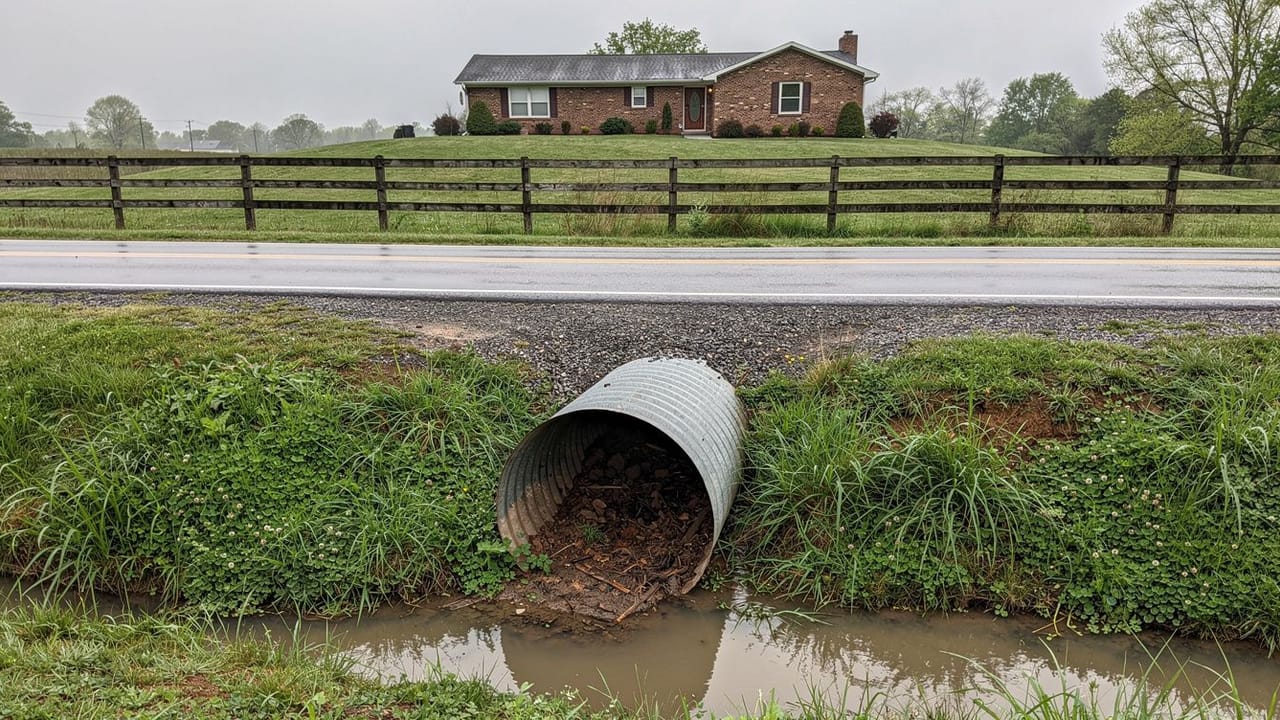
On a property with a ditch along the road, the pipe under the driveway has to pass everything the ditch collects upstream. When it chokes, the water keeps coming and backs up over the driveway, the road or the yard, and Metro Water Services’ stormwater maintenance page warns that blocked or partially blocked ditches and culverts increase the potential for property flooding.
What blocks a driveway culvert?
Sediment, mostly. Whatever soil the runoff is carrying settles out once the water slows down, and the inside of a culvert is one of the places it slows. Metro’s stormwater manual chapter on culvert hydraulics recommends at least 2.5 feet per second, flowing full, for a pipe to clean itself, and suggests a sediment trap upstream where flows will be slower than that. The layer builds along the bottom of the pipe, and Minnesota DOT’s guidance on culvert sediment notes that accumulated sediment reduces a culvert’s hydraulic capacity and can lead to flooding of the roadway.
Then whatever lodges at the ends: leaves, grass clippings, gravel washed off the driveway, the branches a storm brings down. Metro Water Services asks owners to keep stormwater conveyances clear of trash and debris for exactly this reason. We look at the inlet first, where the ditch hands its load to the pipe, before anyone decides the whole run is plugged.
Does a backed-up culvert need cleaning or a bigger pipe?
Water backing up in ordinary rain, with a pipe that is visibly part full of silt, is a maintenance problem, and clearing it puts things right. Metro’s driveway pipe policy, RoM-6, commits to clearing any obstruction that keeps a driveway pipe from working as designed, and allows a pipe to be replaced when it is so obstructed that replacing it costs less than clearing it. On a short pipe we start with hand tools at both ends before bringing anything heavier.
Water topping a clean, clear culvert in heavy rain is a capacity problem, and the usual answer is a larger pipe. A second pipe alongside the first is not the default in Davidson County, since Metro’s culvert chapter says multiple pipe culverts are discouraged when other alternatives are available. Development upstream moves the numbers over time: EPA’s review of urban stormwater runoff explains that impervious surfaces reduce infiltration and increase surface runoff, so roofs and pavement built uphill send more water to the same pipe from the same rain.
- Clear both ends before assuming the pipe is blocked
- Silt along the bottom of the pipe reduces capacity quietly
- Check the ditch grade upstream and downstream, not just the pipe
- A pipe too damaged or packed to clear gets replaced
- Erosion at the outlet means water is leaving too fast
The ditch matters as much as the pipe
A culvert only works if the ditch brings water to it and carries it away afterward. A ditch that has silted flat or grown thick with vegetation will pond water whatever shape the pipe is in, and in Nashville the vegetation is the owner’s to manage: Metro’s policy on vegetation in the conveyance system, RoM-11, puts vegetative control and maintenance on the property owner whether or not there is an easement, and Metro does not mow ditches.
Grade is the thing to check. Water needs a continuous fall through the ditch, into the culvert and out the far side, and RoM-6 says the bottom of the pipe shall match the flow line of the ditch; a pipe set high leaves a pool in front of it that fills with sediment. At the outlet, the manual’s chapter on outlet protection says the change from a pipe to an open channel often creates high velocities and erosive flow, which is why a scoured hole below the pipe deserves attention. Sometimes the fix turns out to be the ditch line, regraded the way we regrade a yard to move water away from a house, and the pipe was never the problem. If the trouble is water running down the driveway itself rather than along the road, our post on channel drains and catch basins for driveways covers that side.
Who is responsible, and permits
It depends on where the property sits. Metro’s stormwater service area, according to policy RoM-1, is Davidson County outside Belle Meade, Berry Hill, Forest Hills, Goodlettsville, Oak Hill and Ridgetop. Inside it, Metro Water Services lists roadside ditches and driveway pipes among the services it manages, while weeds, mowing and runoff from one private property to another stay with the owners. On a state route, TDOT’s highway entrance permit puts the cost of constructing and maintaining an approved driveway access on the owner. In the surrounding counties, ask the county highway department, and ask before assuming either way.
Replacing or installing a culvert in the right of way needs approval, because the size and placement affect drainage for everyone downstream. In Nashville, Metro’s transportation permits page says all right-of-way permits are applied for through ePermits, and RoM-6 sets a replacement driveway pipe at no less than 15 inches in diameter. That approval is useful protection as well, since a pipe installed to the required size and grade is a pipe someone else has signed off on. Where the digging is ours to do, our excavation work covers setting the pipe and shaping the ditch, and a free estimate starts with us walking the ditch line with you.
Sources
- Metro Water Services, Stormwater Maintenance — Blocked ditches and culverts increase flooding potential; keep conveyances clear of debris; MWS manages roadside ditches and driveway pipes; owners keep weeds, mowing and private-to-private runoff
- Metro Water Services, Operating Policy RoM-6, Driveway Pipe Maintenance (rev. 2016) — Metro clears obstructions in driveway pipes; replacement when clearing costs more; pipe bottom matches the ditch flow line; replacement pipe no less than 15 inches
- Metro Water Services, Operating Policy RoM-1, Service Area (rev. 2016) — Davidson County excluding Belle Meade, Berry Hill, Forest Hills, Goodlettsville, Oak Hill and Ridgetop
- Metro Water Services, Operating Policy RoM-11, Vegetation in Conveyance System (rev. 2016) — Vegetative control in conveyance systems is the property owner’s responsibility, easement or not
- Metro Nashville Stormwater Management Manual, Vol. 2 Ch. 5, Culvert Hydraulics — 2.5 ft/s self-cleaning velocity and upstream sediment trap; multiple pipe culverts discouraged; sizing by nomographs; 15-inch minimum culvert
- Metro Nashville Stormwater Management Manual, Vol. 2 Ch. 10, Outlet Protection — Pipe-to-channel transitions create high velocities and erosive flow at the outlet
- Minnesota DOT, Cleaning of Stormwater Pipes and Culverts: Sediment Management — Accumulated sediment reduces culvert hydraulic capacity and can flood the roadway
- US EPA CADDIS Vol. 2, Urbanization: Stormwater Runoff (January 2021 archive) — Impervious surfaces reduce infiltration and increase surface runoff
- TDOT, Highway Entrance Application and Permit (rev. 2017) — On state routes the owner bears the cost of constructing and maintaining an approved driveway access
- Metro Nashville Department of Transportation, Permits — All right-of-way permits are applied for through ePermits
FAQ
Driveway Culverts and Ditches That Stop Working — questions
Who is responsible for the culvert under my driveway?
In Davidson County, outside Belle Meade, Berry Hill, Forest Hills, Goodlettsville, Oak Hill and Ridgetop, Metro Water Services lists roadside ditches and driveway pipes among the stormwater work it manages, and its driveway pipe policy commits to clearing obstructions. Mowing and vegetation in the ditch stay with the owner. On a state route, TDOT’s entrance permit makes the owner responsible for maintaining the driveway access, and in other counties the county highway department is the call to make before a dispute or an expense.
Can I clean a culvert myself?
Inside Metro’s service area, report a blocked driveway pipe to Metro Water Services first, since clearing obstructions is part of its stated policy; keeping the grass and weeds down around it is yours. Elsewhere, silt and leaves at the ends of a short pipe can come out with hand tools. Take care working in a roadside ditch beside traffic, and stop if the pipe is crushed or packed solid, since that is a replacement job rather than a cleaning.
How do I know if my culvert is too small?
If it overtops when it is verifiably clear and the ditch is running properly, it is too small for the water reaching it, and new roofs and pavement upstream can be the reason. Sizing is calculated: Metro’s stormwater manual sizes culverts from the design charts in its culvert chapter and sets a 15-inch minimum pipe, and the permitting authority will specify what is required.
What size culvert do I need for a driveway?
In Davidson County, no less than 15 inches across for a replacement driveway pipe, under Metro’s RoM-6 policy. Above that floor, the size is worked out from the water the ditch delivers, using the design charts in Metro’s stormwater manual, and the permitting authority sets what goes in. A second pipe beside the first is discouraged.