
· by Michael Blair, Nashville's Drainage and Excavation
Most yard drainage problems come down to one of two kinds of water: rain running across the surface toward somewhere it should not go, and water already soaked into the ground with nowhere to leave. A swale handles the first. A French drain handles the second. Plenty of yards get the wrong one, and on Middle Tennessee clay the mistake shows up quickly. Here is how we tell the two apart on a lot, what the residential code and Metro’s own design manual say about shaping a swale, and when a yard needs both.
What is the difference between a swale and a French drain?
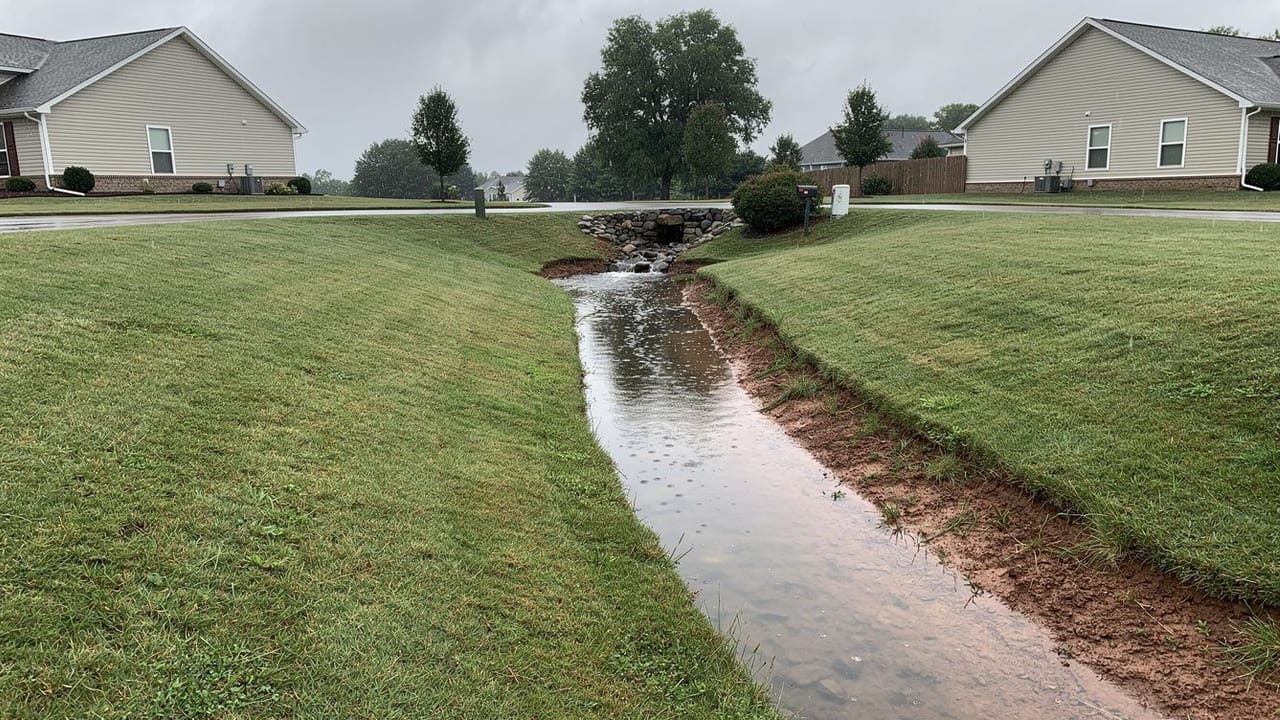
A swale is a shallow, grassed channel shaped into the ground that carries surface water across a yard, while a French drain is a gravel-filled trench with a perforated pipe that collects water from the soil and carries it away underground. One moves water you can watch running in a storm. The other moves water you find when you dig.
Metro Nashville’s Low Impact Development manual, Volume 5 of its stormwater manual, describes its version of a swale, the grass channel, as an open, vegetated channel built to slow runoff down while it moves it, so that some of what the water carries settles out on the way. That is the useful part on a house lot: a swale moves water at an easy pace instead of a rush, and you can see whether it is working.
A French drain earns its place where the ground itself stays wet. How one should be built, with the right gravel, fabric and outlet, is in what a French drain should actually be.
When does a yard need a swale?
A yard needs a swale when surface water has to be carried around or past something, a house, a property line, a patio, and there is not enough fall to do it by grading alone. The residential code says nearly the same. Under Section R401.3 of the International Residential Code, as published for Tennessee, the ground must fall at least 6 inches in the first 10 feet away from a foundation, and where lot lines, walls, slopes or other barriers make that impossible, drains or swales have to be built to take the water away from the house.
That exception describes a lot of Nashville lots: two houses a dozen feet apart, a back yard that rises toward the house, a driveway cut across the slope. In each, storm water arrives as a sheet off a roof, a lawn or the yard next door, and a shallow swale between the houses or along the uphill side catches it and turns it toward the street or another safe outlet. The same section asks that paved surfaces within 10 feet of the foundation slope at least 2 percent away from the house.
How we read where water goes on a lot before choosing anything is in where water should go on a Nashville lot.
How is a drainage swale shaped?
A drainage swale is shaped wide and shallow, with gentle side slopes and a steady, modest fall along its length, so the water moves without tearing out the grass. Metro’s manual prefers a trapezoid with a flat bottom 4 to 8 feet wide, which a narrow side yard often cannot fit; there we keep the sides gentle and the bottom as wide as the space allows. It also has the channel bottom stabilized with grass quickly, and we do the same before a swale is asked to carry a storm. How we shape the ground itself is on our grading and regrading page.
The manual’s design numbers are written for grass channels on development sites. We use them as the yardstick on residential work:
- Side slopes no steeper than 3 feet across for every foot of drop, so the swale can be mowed, and flatter where there is room
- A fall along the channel of about 1 to 2 percent to avoid scour; up to 4 percent is acceptable, though it will likely need check dams
- Check dams, where used, no more than 12 inches high, with a weep hole so they empty after a storm
- The channel bottom kept at least 2 feet above the seasonally high water table and above bedrock
- The channel set back at least 10 feet downhill from a building foundation, 50 feet from a septic field and 100 feet from a private well
When a French drain is the better answer, and when it takes both
A French drain is the better answer when the problem is ground that stays saturated rather than water running across it, or when there is no room for a swale’s gentle slopes. A soggy strip that never dries, water seeping out of a bank, or a wet patch tight against a foundation, where a swale could not keep its 10-foot setback, all point underground. Clay sharpens the choice: Metro’s manual credits grass channels on the slow-draining C and D soils with only 10 to 20 percent runoff reduction, against 20 to 30 percent on the sandier A and B soils. On most clay, a swale moves water rather than soaking it in.
Some yards need both. Metro’s low impact development page carries water quality swale drawings with an underdrain and without one, which is the same idea as a swale with a French drain beneath it: the channel carries the storm on the surface, and the pipe under it drains the soil between storms. We consider it on any lot where the low line of the yard stays wet after the surface water has gone, in Franklin or anywhere else we work.
Either way, every drain needs an outlet the water can reach. Our French drains page covers the underground half. If you are not sure which kind of water you have, ask us to walk the yard.
Sources
- Metro Nashville Stormwater Management Manual, Volume 5: Low Impact Development (2021), GIP-07 Grass Channel — Grass channel purpose; 4 to 8 foot bottom; side slopes 3:1 or flatter; 1 to 2 percent fall, up to 4 percent with check dams; check dams 12 inches or less with weep holes; 3-inch treatment depth and 6 inches of freeboard; 2 feet above water table and bedrock; setbacks of 10, 50 and 100 feet; runoff credit by soil group.
- 2018 International Residential Code as published for Tennessee, Section R401.3 Drainage (UpCodes) — Grade falls 6 inches in the first 10 feet; where barriers prevent it, drains or swales are required; paved surfaces within 10 feet slope at least 2 percent away.
- Metro Water Services, Low Impact Development — Lists the LID manual and the GIP-05 water quality swale drawings with and without an underdrain.
FAQ
Swale or French Drain: Which One Your Yard Needs — questions
Is a swale better than a French drain?
Neither is better in general, because they handle different water. A swale carries surface runoff across a yard in a shallow grassed channel. A French drain collects water already in the soil through a perforated pipe in gravel. Water running across the yard in storms points to a swale; ground that stays soggy between storms points to a French drain.
What is a drainage swale?
A drainage swale is a shallow, grassed channel shaped into the ground to carry surface water away from a house or across a yard to a safe outlet. Metro Nashville’s design manual calls its version a grass channel and gives it gentle side slopes, a modest fall along its length and grass to slow the water.
How deep should a drainage swale be?
Shallow. Metro’s manual designs grass channels so everyday flow runs 3 inches deep or less, with at least 6 inches of extra depth for larger storms. Width matters more than depth: side slopes no steeper than 3 to 1 keep a swale mowable and the water slow, and the bottom should stay 2 feet above the seasonal water table.
How close to a house can a swale run?
Metro’s design manual sets grass channels back at least 10 feet downhill from a building foundation. Inside that distance, the code’s answer is grading, with the ground falling at least 6 inches in the first 10 feet. Where a lot cannot fit both, a French drain or solid pipe usually takes the water instead.
Does a drainage swale need grass?
A grassed swale works because the grass slows the water and holds the soil. Metro’s manual has the channel stabilized with grass quickly and limits how fast water may run over each kind of turf. Where flow is too fast for grass alone, check dams slow it, and the ground behind them may need armoring with stone.