
· by Michael Blair, Nashville's Drainage and Excavation
A sump pump moves collected groundwater away from the house. Both halves of that, the collection and the moving away, have to work, and so does the power. Most of the pits we deal with are fed by a perimeter drain of the kind described on our French drain page, so when the pump stops, the water that drain gathers has nowhere left to go.
Where should a sump pump discharge?
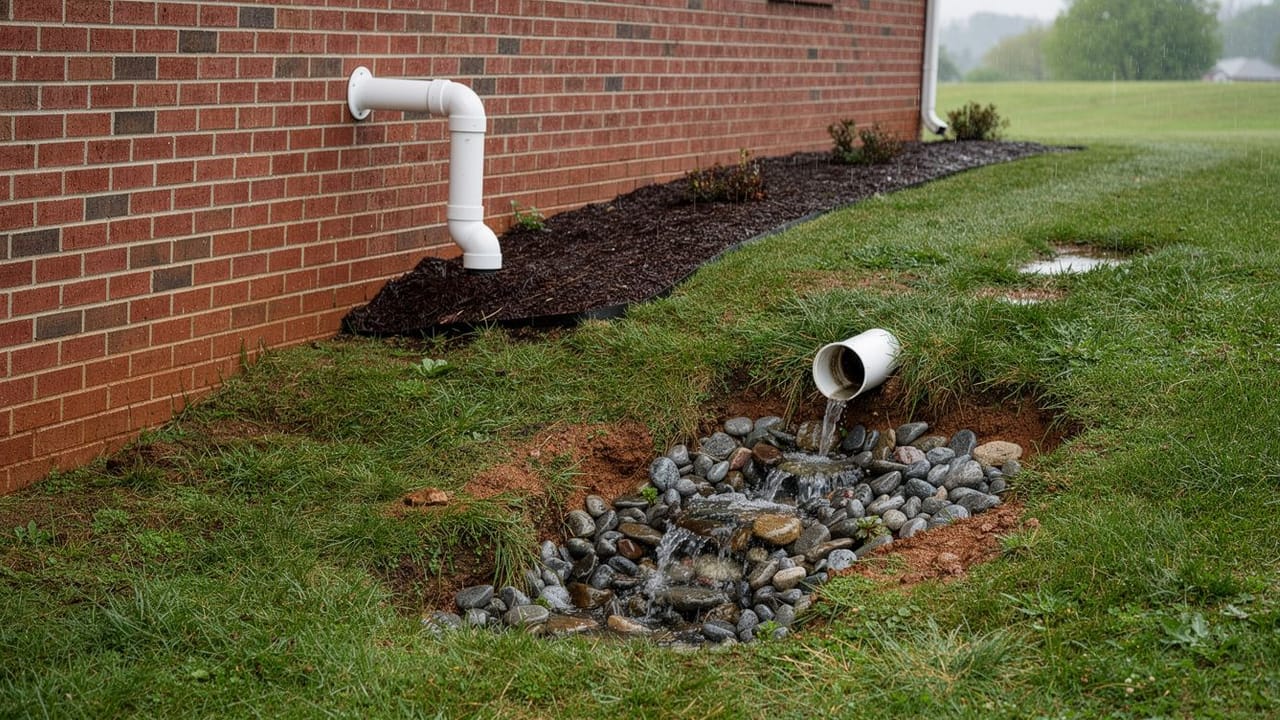
We run the line out to a point lower than the house instead of letting it out beside the wall. Water dropped next to the foundation can soak back down to the drain the pump just emptied, and then the pump spends its life moving the same water in a circle. Our post on where water should go on a Nashville lot is about finding that lower point before anything gets dug.
Metro has adopted the 2024 International Residential Code and the 2024 International Plumbing Code, according to Metro Codes’ adopted codes list, and Zoeller’s installation instructions for its sump and effluent pumps tell the installer to review every code that applies and check the job against each one. The same manual says not to use a discharge pipe smaller than the pump’s outlet, and it pairs the check valve with a vent hole. On our side, we keep the outside end of the line where a mower, a fresh load of mulch or a parked car cannot crush or bury it.
Why does a sump pump need backup power?
Heavy rain fills a pit, and the storms that bring it can cut the power on the same night. After storms crossed Davidson County on a Monday night in late April 2026, Metro’s Office of Emergency Management reported about 16,351 NES customers without power, along with flooding and downed trees.
FEMA’s Ready.gov flood guidance suggests considering a sump pump with a battery, and a battery unit is the backup we would add first to any pit that has run hard during a storm. A pump with no backup is out of action on exactly the night the lights go out.
- Discharge to a lower point, not back onto the perimeter
- Battery backup, worth having here
- Check valve with the vent hole the pump maker specifies
- Test the pump at least every three months
- Never discharge into a sanitary sewer
Testing it
Our test is a bucket of water poured into the pit while we watch three things: the float rises, the pump kicks on, and water comes out the far end of the line outside. Zoeller asks for a test as soon as the pump is installed and an inspection and test at least every three months after that, so we suggest tying it to the change of each season.
A pit that stayed dry through a long summer is the one to test before the fall rains arrive, not during the first of them.
Never into the sewer
Sending a sump into the sanitary sewer is generally prohibited here. An older Metro Water Services and Public Works directive on cooperative discharge cites Metro Code 15.60.100 and 15.60.110 as prohibiting uncontaminated storm water from going to the sewage treatment plant, and says Metro Water Services has spent over $800 million to stop the overflows and bypasses that storm water caused there. Confirm the current rule for your address with Metro Water Services before any connection is made.
EPA’s answers on sanitary sewer overflows list sump pumps among the connections that can overload a sanitary sewer, and say a basement flooded by an overflow has to be thoroughly cleaned and disinfected. The surface is where this water belongs. Metro’s illicit discharge ordinance lists uncontaminated pumped groundwater, foundation drains, footing drains and crawl space pump water among the discharges allowed into the storm system, unless the director has identified them as a source of contaminants. If your pump needs a new outlet, ask us for a free estimate.
Sources
- Metro Codes, Adopted Codes List — Metro has adopted the 2024 International Residential Code and 2024 International Plumbing Code
- Zoeller Co., Sump/Effluent Pump Installation Instructions FM0447 (distributor copy) — Review all governing codes; discharge pipe no smaller than the pump discharge; vent hole for the check valve; test after installation and at least every 3 months
- Metro Office of Emergency Management, Prepare for More Potential Severe Weather on Tuesday (2026-04-28) — Storms caused power outages and flooding in Davidson County; about 16,351 NES customers without power
- FEMA, Ready.gov, Floods — Install check valves; consider a sump pump with a battery
- Metro Public Works and Metro Water Services, Cooperative Discharge Directive — Metro Code 15.60.100/110 prohibits uncontaminated storm water to the treatment plant; over $800 million spent on overflows and bypasses
- US EPA, Sanitary Sewer Overflow (SSO) Frequent Questions (January 2017 archive) — Sump pump connections can overload a sanitary sewer; flooded basements must be cleaned and disinfected
- Metro Water Services, Illicit Discharge Ordinance (Metro Code 15.64.205) — Pumped groundwater, foundation and footing drains and crawl space pump water allowed to the storm system unless identified as contaminant sources
FAQ
Sump Pumps and Where They Discharge — questions
How far should a sump pump discharge from the house?
Far enough that the water cannot run back down to the perimeter drain the pump is emptying. Rather than working to a set number of feet, we take the line to a point lower than the house, or to the storm system where one is close. Metro’s illicit discharge ordinance allows uncontaminated pumped groundwater and foundation drain water into the storm system unless the director has named it a source of contaminants.
Do I need a sump pump backup in Nashville?
It is worth having. FEMA’s Ready.gov flood guidance suggests considering a sump pump with a battery, and the storms that fill a pit can also cut the power, as the late April 2026 storms did for thousands of NES customers in Davidson County. A pump with no backup stops at the moment the pit is filling.
Can a sump pump discharge into the sewer?
Generally not. An older Metro Water Services directive cites Metro Code 15.60.100 and 15.60.110 as prohibiting uncontaminated storm water from going to the treatment plant, and EPA lists sump pumps among the connections that can overload a sanitary sewer. Check with Metro Water Services for your address, and send the discharge to the surface or the storm system instead.
How often should a sump pump be serviced?
Zoeller’s instructions call for a test as soon as the pump is installed and an inspection and test at least every three months after that, so we tie it to each change of season. Pour a bucket into the pit and watch the float rise, the pump start and water leave the far end outside.