
· by Michael Blair, Nashville's Drainage and Excavation
Ground beside a house can settle over the years, and beds can get built up with mulch one spring after another. Either can leave the ground sloping toward the foundation, which is the wrong direction on any lot: HUD’s site grading and drainage guidelines call for surface water to drain away from all sides of a building, to keep the soil that supports it from misbehaving. On clay it is worth getting right, and the ICC’s commentary on the residential code’s drainage section notes that certain clays are highly expansive. If you are still working out where the water on your lot should end up, our post on where water should go starts there.
Recognizing it
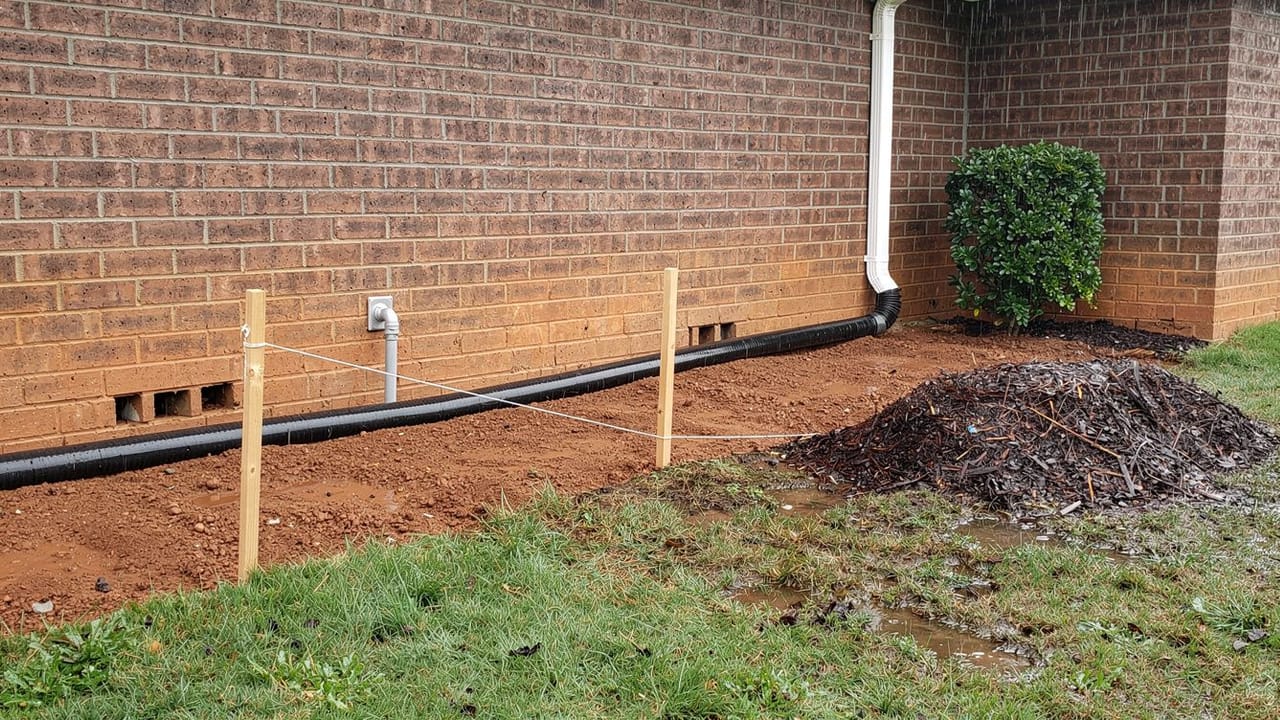
Stand at the wall and look outward. Water should visibly run away. Mulch or soil piled above the brick ledge or against siding is a clear sign, and University of Illinois Extension’s drainage guide for homeowners says plainly not to pile soil against siding. A bed that ponds after rain deserves a closer look too, since preventing standing water is one of the stated objectives in HUD’s grading guidelines.
A string line and a level settle the question over ten feet. The figure to hold it against comes from section R401.3 of the International Residential Code: the ICC’s commentary says the final grade must fall at least 6 inches within the first 10 feet from the foundation, though it also lets an inspector judge drainage by eye without measuring.
How is ground that slopes toward the house corrected?
We add soil to build fall away from the house, keeping the finished grade below the siding line and below any weep screed or brick weep holes. HUD’s guidelines ask for the same 6 inches in 10 feet regardless of soil type. Where a side lot line makes that impossible, the ICC commentary allows the water to be sent to a swale or a drain instead, and any paved surface within those 10 feet needs its own slope away from the wall. Metro Codes’ list of adopted codes shows Nashville on the 2024 edition of the residential code, while the State Fire Marshal’s office lists the 2018 edition, with amendments, as the statewide minimum, so we check which applies in the town the house sits in. How we shape and compact the new grade is set out on our yard grading page.
The fill matters as much as the slope. Before any soil goes down, Illinois Extension says to rake back wood or rock mulch and organic groundcover, which do not compact well. Fairfax County’s soil and water conservation district advises soil with a relatively high clay content against the foundation, and the Department of Energy’s building science guidance caps the grade with 2 to 4 inches of silty clay, compacted mechanically. The aim is for water to run off the surface rather than soak in beside the footing.
- At least 6 inches of fall over the first 10 feet, or a swale or drain where the lot is too tight
- Keep grade below siding, weep screed and brick weeps
- Rake back old mulch before adding soil
- Compacted clay-bearing fill, not mulch or loose organic material
- Do not bury the brick ledge or cover weep holes
- Combine with downspout extensions
Do not bury the wall
Brick veneer drains through its weep holes. Knox County’s brick installation handout, written from the 2018 code, puts the flashing behind the first course of brick above finished grade and the weep holes immediately above that flashing. Raise the soil over them and any water that gets behind the veneer has no way out. We keep a weep screed at the base of stucco clear for the same reason.
It is an easy mistake to make in the middle of fixing a drainage problem, and it leaves the wall with nowhere to drain.
Should regrading go with downspout extensions?
Regrading and downspout extension work together, because good grade does far less when the roof’s water is dumped onto it beside the wall. Fairfax County’s guide lists downspout extensions alongside swales, French drains and catch basins as ways to redirect runoff, and HUD’s guidelines call for immediate diversion of water away from buildings.
When the trouble is surface water rather than groundwater, we start with those two before pricing anything buried. If your downspouts already run into a pipe, our downspout drainage work covers what we check on it. To have us shoot the grade around your house, ask for a free estimate.
Sources
- International Code Council, Code Basics: IRC Drainage (R401.3) commentary (2011) — Final grade falls at least 6 inches in the first 10 feet; visual verification allowed; swales or drains where lot lines prevent it; paved surfaces need their own slope; certain clays highly expansive
- U.S. HUD, Handbook 4145.1 Appendix 8, Site Grading and Drainage Guidelines — Drain away from all sides of buildings to prevent adverse soil behavior; prevent ponding; 6 inches in 10 feet regardless of soil type; immediate diversion away from buildings
- University of Illinois Extension, Landscape Drainage for Homeowners (2020) — Avoid piling soil against siding; rake back mulch and organic groundcover, which do not compact well
- Metro Nashville Codes, Adopted Codes for Metro Nashville — Metro Nashville has adopted the 2024 International Residential Code
- Tennessee State Fire Marshal’s Office, Currently Adopted Codes — 2018 International Residential Code, with amendments, as the statewide minimum
- Fairfax County Soil and Water Conservation District, Wet Yard: Solving Drainage Problems — Fill with relatively high clay content near the foundation; downspout extensions, swales, French drains and catch basins to redirect runoff
- U.S. Department of Energy, Site is Excavated: Final Grade is Sloped Away from Home — Cap the grade with 2 to 4 inches of silty clay and compact it mechanically
- Knox County Code Administration, Brick Installation Information (2018 IRC) — Flashing behind the first course of brick above finished grade; weep holes immediately above the flashing
FAQ
Regrading Around a Foundation That Settled — questions
How do I know if I have negative grade?
Look along the ground away from the wall after rain and see which way water runs, or run a string line and a level over the first ten feet. The model residential code asks for at least six inches of fall over that distance. Mulch or soil piled above the brick ledge or against siding is a clear indicator, and so is a bed that holds water after a storm.
What soil should I use to regrade?
A compacted fill with a relatively high clay content, rather than mulch or loose organic material. The aim is to shed water across the surface away from the house, not to give it an easy path down beside the footing. Organic material compacts poorly and settles back toward the wall, which is why the usual guidance is to rake back old mulch first and cap the new grade with a few inches of compacted silty clay.
Can I raise the ground up against the siding?
No. Grade must stay below the siding line, any weep screed and brick weep holes. On brick, the flashing sits above finished grade and the weep holes sit just above the flashing, so they are the way out for water that gets behind the veneer. Bury them and that water has nowhere to drain.
How do I regrade around my foundation?
Rake back the old mulch, then build up compacted fill with a good share of clay so the ground drops at least 6 inches over the first 10 feet. Keep the new grade under the siding line and the brick weep holes, give any paving its own slope away from the wall, and extend the downspouts too.